Mark Zuckerberg famously said about his company, Facebook, that, ‘we don’t help people connect more efficiently to make money, we make money to help people connect more efficiently.’ In other words, it’s not about the money, it’s about the mission.
It’s been said that people who believe that money can’t by
happiness don’t know where to shop.
That, or they’ve never seen the looks on the faces of little
kids when they come down for Christmas. Or the ecstasy of a teen with a new
iPhone. Or the smile of a spouse when they get a new car.
We understand that we were designed by God to enjoy material
things, in the right way of course. The point though, is that there is a right
way.
In Sunday’s Gospel Jesus warns us about the perils of greed,
that it can lead to selfishness and ignorance of the plight of the needy. But
more importantly Jesus opens us up to the possibilities of living more
fulfilled and purposefully by longing for something else.
Mark Zuckerberg famously said about his company, Facebook, that, ‘we don’t help people connect more efficiently to make money, we make money to help people connect more efficiently.’ In other words, it’s not about the money, it’s about the mission.
And this seems to be what Jesus is saying – go ahead and
have your new iPhone, but don’t let your new iPhone have you. It is a
capricious and unfulfilling God (as all Verizon customers know…) and it will
cause you to focus on the wrong thing and become less of the person you want to
be.
So if it’s not about the money but the mission, how do you
define your mission? If you can’t, what’s that mean? If you can, what’s it
calling you to focus on right now?
------------------
Reading
Robinson Crusoe – Daniel DaFoe
The Good of Affluence – John Schneider
Rich Christians in an Age of Hunger – Ron Sider
A chaplain friend was visiting patients in a hospital when
he stopped to see a woman who had just been admitted. At the conclusion of
their conversation he asked if he could pray for her. She told him very
politely, “No thanks, I don’t believe in prayer. I don’t believe it does
anything and I think it’s a waste of time.” My friend heeded her request, they
continued their conversation, and then parted on a pleasant note.
This Sunday we hear from someone who had a much different
take on prayer. As we know, Jesus was a serious pray-er. He often went to
solitary places and stayed up all night to pray. Jesus was so convinced of the
necessity of prayer that He taught us what became the most famous prayer in the
world: The Our Father. Jesus
articulated exactly how we should pray, what we should ask for, how persevering
we should be, and how apt God is to respond. In contrast to the woman in the
hospital bed, Jesus seems convinced that prayer does things, it is not a waste
of time, and God does seem to care about our piddly concerns.
So from the perspective of someone who never prays, we hear
how useless it is. While from the perspective of someone who prays often (and happens to be God...) we
hear it is a lifeline. This may lead us to ponder that the reason we don’t see the
importance of prayer in our lives may be because we’re not doing it enough.
Perhaps we're being encouraged to spend less time questioning prayer and more
time doing it.
--------------
Reading
Robinson Crusoe – William DeFoe
Free – Mark Scandrette
Practicing Resurrection – Eugene Peterson
Just sitting down to write you this morning has been an exercise in distraction all its own – emails, phone calls, and text messages are just the start. How about your morning?
The truth is that our lives are full of potential distractions
– jobs, family, media, and free time (what’s that?)… And in Sunday’s gospel we
hear how we might deal with them.
We pick up our story with a visit from Jesus to a friend’s
home, where Martha and her sister Mary played host. It’s commonly assumed that
Martha was busy taking care of guests while Mary just sat around - hence, Jesus
chastised Martha for her distraction and commended Mary for her attention. However
that’s not what the text says. We get no indication that Mary didn’t have as
many tasks to tend to as Martha. What we do get is the idea that Martha allowed
these tasks to distract her.
The importance of this distinction is that you and I often
feel like the spiritual life is one in which we lock ourselves into solitary
confinement, shunning responsibility, and wearing such heavy blinders that
we’re oblivious to all that might divert us.
As we know, this is not our present reality. We can never
prevent distractions, but we can improve the way we deal with them. Mary’s good
decision wasn’t that she was bereft of distraction, it’s that she did not heed
them, Mary put aside her diversions and focused on what was most important:
Christ’s voice in her life.
What are we allowing to take us away from the voice of Jesus?
How are we allowing the less important to supplant our awareness of God’s
presence? What priorities need
resetting and precedents need reexamining? Distractions are often only
distractions when we allow them to be so.
---------------
Reading:
Practicing Resurrection – Eugene Peterson
Switch – Chip and Dan Heath
Resilient Ministry – Burns. Chapman, Guthrie
How mediocre has your walk with Jesus been?
Have you been too busy to pray?
Have you spoken badly about your neighbor, employees, or
children? Are you feeling a bit shameful about it? Or are you feeling guilty
because you’ve been a bad parent, watched something you shouldn’t have watched,
said something you shouldn’t have said, and done some things you really don’t
want anybody else to know about?
That’s what society calls a ‘sinner.’ We feel shame,
embarrassment, humiliation and we beat ourselves up because we’re Christians
and we should know and do better.
Which is what Jesus addresses in this Sunday’s Gospel.
We join Jesus as he has dinner at another rabbi’s house. But
instead of commending the rabbi for his stellar religious observance, Jesus
commends the person who was at the opposite extreme. Jesus lifts up a woman branded
as a sinner, who can only cry and wash his feet with her tears. She commends to
us a notion that just may bring you new life today:
Perfect fidelity has never been a requirement of following
Jesus.
What are you beating yourself up about right now? Your
laziness? Your busyness? Your anger?
Sure, we can rationalize and distance ourselves from our own
messes. Or we can be like that unknown woman, that sinner, who simply fell at
Jesus’ feet – in worship, compassion, and humility. Jesus isn’t impressed with
all the good deeds you brought to church today. Jesus isn’t in awe of the great
ways you’ve managed to keep the train on the tracks. Jesus is in awe when we
agree to be ourselves. And we say we’re sorry. Admit to the truth. And cling to
Him to take it from here.
How might we do that today? Forgive yourself. Our
expectations should not be higher than God’s
-------------------
Reading
Switch – Heath Brothers
Damn Few – Rorke Denver
The death had come suddenly and unexpectedly.
He was the only son of a widow with no health insurance or
viable means of support, a strapping young man who was very smart and very
capable.
So when she came home from shopping to find him sprawled out
on the living room floor she absolutely lost it.
Being Jewish, the funeral would be the next day. And the
flood of emotion kept her up all night. When the undertakers arrived and the
solemn procession to the cemetery ensued, she was comforted little by all the
people joining her.
As the procession neared the cemetery a stranger approached.
He stopped the parade, called to the corpse to wake up. And the young man did.
We can’t imagine the ensuing emotion.
God had brought to life something humanity had pronounced
dead. This is what God does.
What if everything that’s ever died will live again?
What if the break up, bankruptcy, depression, and funeral
are not the end?
Friends, we may be going through the worst of times (would
anyone trade places with that widow?) and God wants us to know that death is
not the end.
So what have we declared dead in our lives? Our marriage, our financial situation,
our hope of ever finding meaningful work?
God is working to restore, rebuild, and resurrect. We are the widow. We
are the young man. We are the inheritors of resurrection. So why are we letting
the things that are bothering us, bother us? Why do we mourn as if we had no
hope? We are in God’s hands and God brings life to things that are dead.
Period.
--------------
Reading
Thin Blue Smoke – Doug Wargol
Switch – Heath Brothers
The Online Teaching Survival Guide – Boechtter and Conrad
It’s been said that all around us people are tiptoeing
through life.
Staying close to shore. Not taking chances. Allowing their dreams to visit them only when they’re sleeping.
However, to tiptoe through life in order to arrive safely at death is not a good recipe for contentment, much less meeting the potential we’ve been given.
A far better way is to run, hop, skip, dance, create, and imagine our way through life – anything but tiptoe.
What makes us tiptoe is fear. And much of our fear is so
deeply ingrained we can’t begin to name it. But it rules and dominates us in
ways we really don’t like.
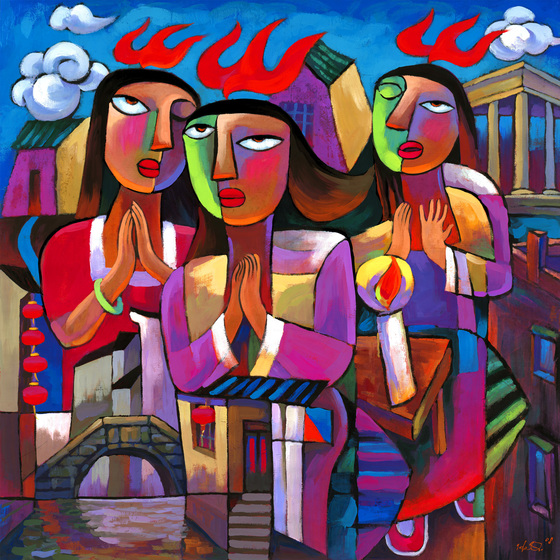
This is why you and I desperately need Pentecost.
This Sunday we are celebrating this church feast, which commemorates the coming of God’s Spirit to be with us. This is not to say we didn’t have God before, or that we now have some sort of double-dose. What it does say is that you are beloved by a God who is in you. You are watched over by God. You are not alone. No matter what happens all will be well because you have God and God has you.
In what ways are you tiptoeing through life? In what ways do you need to get more risky? How might you better grab hold of the fact that God is in us and with us and isn’t going anywhere?
----------------
This is why you and I desperately need Pentecost.
This Sunday we are celebrating this church feast, which commemorates the coming of God’s Spirit to be with us. This is not to say we didn’t have God before, or that we now have some sort of double-dose. What it does say is that you are beloved by a God who is in you. You are watched over by God. You are not alone. No matter what happens all will be well because you have God and God has you.
In what ways are you tiptoeing through life? In what ways do you need to get more risky? How might you better grab hold of the fact that God is in us and with us and isn’t going anywhere?
----------------
Reading
Thin Blue Smoke – David Worgul
Switch – Heath Brothers
The Online Teaching Survival Guide – Boechtter/Conrad
The most difficult time for a mother is arguably not giving birth.
But it is that time in a child’s life when Mom has to say goodbye.
Whether it’s a high school graduation, college graduation, or when the moving van pulls up to the house and (finally) moves junior away from the basement bedroom.
This Sunday Jesus talks about Him and the Father being one. And no one understands the oneness of two better than a mother.
Yet, just as it was ordained that the Son would leave the Father to do the work that only the Son could do, so too, do we know that it is ordained that our children will leave us to do the work they have been called to do.
And just as the Father looked with joy upon the accomplishments of the Child, so too, do we - knowing that it is not forever, but that there is a great reunion planned that will bring us all back together to live as one, in One. And at that reunion all things will be repaired - whether we have had a good mom or a less than good mom.
Yes, on Mother’s Day we give thanks for the role that only moms can play. But it is also a time to challenge children everywhere that there is work to do. There is a plan for redeeming the world that the Father has ordained - and every one of us has a role to play in that.
So, honoring mom isn’t just about giving her a flower and a card, but it’s about seizing the life she’s given us and doing the best we can with it. Yes, let us give thanks to God for our mothers, recognizing their role in God’s work of restoration - and that the work we do brings honor and glory to all of those responsible for getting us here.
OK, I admit it. I’m a functional atheist.
While I say that God is with me all the time – guiding, protecting, and working alongside me, too often I find that I live my life as if everything depends on me. I make decisions and commitments as if I’m the sole arbiter. I don’t take time to consider that God really does have a plan. And in doing so I act like the God I say is here, really isn’t.
Actually, I don’t think I’m alone here. I think many of us suffer from the same misguided thinking. I think the Church, as a whole, has a hard time owning the promise Jesus gives us in Sunday’s Gospel: ‘The Holy Spirit, whom the Father will send in my name, will teach you everything, and remind you of all that I have said to you.’
So what IF God really is here? And God knows everything I’m facing? That God has gone ahead of me to provide and protect? And that the decisions I’m making really aren’t as determinate upon my own action as I think they are?
So much of the Christian journey is about letting go, letting be, and letting God. It’s as if God is saying, ‘Relax. I’ve got it covered. Be at peace. There’s nothing that can happen to you that I don’t know about. It’s all going to be OK.’ Lord, help me trade my atheism for your provision and realize that you do have the whole world in your hands.
What do you love to do?
I love the process of testing new ideas –
My staff will tell you that our central pursuit here at St. David's is to throw things against the wall and see what sticks.
I love beautiful things. Cars, photographs, and my wife.
I love to read.
I love to cook.
I love to be with people.
And I answer this question because I want you to.
What do you love to do?
Spend a moment on this.
It’s important because what you love to do is why you’re here.
It is the mark of the Gospel work you’ll contribute to the world.
You and I understand that somehow our existence is not of our own making. God was up to something when God made you and me. And the fullness of God’s plan can only come about through every one of us being who God created us to be. And God created us to love. To be love. To do love.
So what do you love to do?
It’s more than just your passive preference.
It’s your mission.
--------------
Reading
Thin Blue Smoke - Don Worgul
God is Red - Liao Yiwu
Damn Few - Rorke Denver
In Boston on Monday, two bombs scattered the sheep.
Many who hadn’t come to race, found themselves running anyway.
Others became shepherds.
They turned their coats into bandages. They carted the injured off to safety. They returned home with bloodstains. Others opened their homes to the stranded. Donated blood. Bowed their heads in prayer.
Coming to the aid of those who suffer is at the heart of what it means to be human. It is here where we find our deepest fulfillment. Given the choice to own a Ferrari, date a celebrity, or save someone’s life I would not be surprised if most people chose the latter.
And God knows this. In fact, this Sunday churches around the world will celebrate Good Shepherd Sunday, which is when we grab hold of that soul-saving notion that, just as God protects and keeps our souls, we are at our very best when we do the same.
So as we move through the myriad of emotions - fear, insecurity, grief, and loss – we do well to consider that our anecdote lies in the courage to stand up, run to the rescue, care for the afflicted, and give of ourselves to those who need it. May the Good Shepherd grant us strength so to do.
A link to some helpful prayers
Reading:
The Guidebook (NRSV Bible)
God is Red – Liao Yiwu
Entrepreneurial Leadershp Goosen and Stevens
The Guidebook (NRSV Bible)
God is Red – Liao Yiwu
Entrepreneurial Leadershp Goosen and Stevens
It’s very possible your best days are behind you.
Many of us suspect this but don’t want to admit it. And so
it can linger inside as despair and sadness, only to come out as anger or
depression - perhaps because we often look at our lives as a series of
accomplishments and once we’ve done the best we’ve done, we’ve lost our
usefulness. What’s more, the less we’ve ‘done’ lately, the more society
relegates us to more distant spheres of irrelevance, which doesn’t help
matters.
Sunday’s Gospel says something about this.
We meet the disciples after Jesus has risen and they have
returned to their work as fishermen. While we suspect they are bewildered and
depressed because their best days are behind them, the text does not tell us
this. What it says is that they were willing to join St. Peter and go back to
work. Then, it is in the midst of this work that, again they notice Jesus, who
provides further proof and encouragement to go off and spread the good news.
If all of life is a gift, then the gift of accomplishment is
just that.
The muse that comes to the four members of the boy band,
giving them a chart-topping hit at age 17 then disappearing forever, is not a
commentary on their creativity as much as it is a sobering insight into the
capriciousness of accomplishment. If we built a business, raised incredible
children, or put in 30 years at the company, great, the muse did her work and
we are no less human, no less beloved, than we were before. We’ve been visited
by a blessing that came from outside of us and over which we had little
control.
This means we are not that blessing. We cannot take credit
for that blessing. We should not feel guilty if that blessing has moved on.
Recognizing that all creativity, originality, insight, and
ultimately accomplishment, originate outside of ourselves and visit us in its
own time, is an incredible stress reliever. It takes off the pressure and frees
us up to, like the disciples, notice Jesus in new places.
Reading
------------
At Canaan’s Edge – Taylor Branch
God is Red – Liao Yiwu
The Guidebook (NRSV Bible)
For the last four months Joan McKenzie did not have a voice.
As she arrived for Easter services last Sunday, the always cheerful Joan had to, once again, rely on her husband Jim to talk. We had a brief conversation, and Joan said she had lost her voice only once before, briefly, following illness. This time, there was no explanation, and no end in sight. She told me she was going to see a specialist in 4 weeks, the soonest she could get an appointment.
Then, a little while later, during our 10 am Easter service, something magical happened.
Joan's favorite hymn, 'Jesus Christ is Risen Today' was being sung. So Joan thought she would try to mouth the words. As she started to do this, words started coming out of her mouth. She could sing! After the hymn she declared to her husband, 'I have my voice back!'
Joan can't explain what happened, but is convinced it's God's doing. She told me she believes it's a reminder that God is inside us and wants to come out, and that it's a message to be kind and thoughtful through difficult times because they don't last forever.
As I ponder this blessing, not only am I inspired to thank God for the gift of healing for Joan, but even moreso for her gift of courage through the adversity she exhibited.
Joan's example, like that of many saints, is one of faithfulness in what really matters: her relationship with Jesus and the promises He's made to always care for her.
May Joan's special Easter gift inspire us all to remember that today's troubles are only for today, and that the Risen Christ is with us every step of the way.