Chris Yaw

I am a Christ Lover

Chris Yaw

Welcome! I’m an Episcopal priest serving a congregation in Metro Detroit... With a passion for gun safety... A zest for online Christian formation... A zeal for video blogging... A budding writer... A heart for those who have unintentionally harmed... A commitment to workforce housing... A love for marrying people... And a wonderful wife, three kids, and a cat... If we have common interests or not, I'd love to connect with you.

Me

Contact Details


  • St. David's Episcopal Church, 16200 W. Twelve Mile Road, Southfield, Michigan, 48076, USA


  • +011 248-557-5430


  • chris@stdavidssf.org

St. David's

I have served as rector of St. David's Episcopal Church in Southfield, MI for 16 years, join us Sundays in person or via zoom.

Disarmory Ministries

Working on the issue of unwanted gun disposal, we've made some real progress in helping rid the U.S. of unwanted firearms.

ChurchNext

Since 2013 we have been helping people learn more about faith through our online learning courses at ChurchNext.

Oakland Housing

Helping middle income families get better housing is a challenge that Oakland Housing has been addressing for 75 years.

Hyacinth Fellowship

Because hurting others hurts us, the Hyacinth Fellowship organizes support groups and reminds us that we are not our worst mistakes.

Yaw Wedding

I have been officiating for more than 20 years and continue to find joy in helping couples build lifelong relationships.

0
U.S. Guns Produced Today
0
Americans Accidentally Killed Today
0
Homeless Americans
0
Weddings Performed
  • Two Friends


    (Photo by Michael Kenna)
    I have two friends.
    One is a doctor. One is a photographer. The doctor thinks the human body is fascinating. He understands how the organs and major systems work. He can rattle off an amazing repertoire of insights into cell structure and nutrition absorption all the way up to the complex intermingling of assorted bodily workings. The body, to a large degree, fascinates him because he knows it so well. My other friend, the photographer, loves the human body as well. He’s taken thousands and thousands of photographs of a wide variety of bodies, of both sexes, of all ages. He can lecture at length about how light bounces off various skin types and how certain poses accentuate certain body parts. He’s fascinated by the body too - even though he has absolutely no idea how it works. This Sunday is called ‘Trinity Sunday.’ It’s a unique feast because we don’t honor a person or an event – like St. Francis or Christmas - but instead we pay homage to a theological construct. In two thousand years of Christian evolution we have come to the conclusion that God is best understood as a mysterious interplay between Father, Son, and Holy Spirit. Yes, some people, like my doctor friend, have keen theological insight into what we mean by ‘Trinity.’ Their understanding of scripture, history, ontology, sociology, and philosophy helps them arrive at rather precise conclusions about what God is all about. Meanwhile, other people, like my photographer friend, choose to bask in the presence of its beauty, whose existence inspires great confidence even though they would never attempt to understand it. On Trinity Sunday, both of these polarities come together; both are accepted, both are honored, and both are equally valid. We acknowledge God in God’s complexity and God in God’s wondrous beauty - for we know that any claim to fully understand God means we have become God. The soul of this day, then, looks for ways to connect with this numinous force who calls both mind and heart to attention. How do we best understand God – with our heart or head? A bit of both? And how is this Holy Trinity stretching our understanding so that we might learn more about our lives and our world?
  • Finding Vocation


    Don’t get all hung up on finding “your calling.”

    In my experience, few people have just one “calling” – there is rarely “one thing” that people have been given to do over the course of what, for most people, is a very long life.

    The fact that the U.S. Bureau of Labor Statistics reports the average American will have 10 different jobs before they reach age 40 metes this out. And, yes, that number is expected to do nothing but grow.

    Sure, everyone has likes and dislikes, which lead us to excel in some areas more than others: that’s how God made us. But our likes and dislikes change over time. Since we usually become better at the things we like (practice isn’t practice, it’s having fun!) this doesn’t mean we can only attempt things that we are already ‘good’ at. It means we should nurture those things we like to do but not limit ourselves to this – after all the first time anyone does anything, they are not good at it.

    So don’t get down on yourself, but try to celebrate the challenge and experience we had going to business school though now we work as a chef. Or graduating at the top at our conservatory class although now we have now found a home in H.R. God gave us many interests and abilities, and thus the possibility of being good at many different things.

    Yes, life may be a series of trying on different hats, but just because we’ve found one that fits doesn’t mean we can never try another. Sure, we can only wear one at a time but life is long enough and God is good enough so that most of us get a chance to experience a wider swath of humanity.

    So keep dreaming and don’t get hung up on finding your life’s one calling. It’s better to accept the complexities of our gifts and desires and concentrate more on identifying today’s groove, living in the now, and the joy of God’s continued gift of vocation.
  • Let Us Pray


    In the classic book ‘Anne of Green Gables’ Miss Cornelia, a staunch Presbyterian, hears that a friend is ailing.

    Cornelia is told the situation is so dire that her friend will now have to, ‘rely on the Lord.’ Cornelia gasps and is overcome with emotion. She replies, ‘Surely, it isn’t as bad as all that!’

    Mark Thibodeaux, a spiritual writer, likes to delineate between four kinds of prayer. The first, is the one that Cornelia is edging around –  prayer when ‘you haven’t got a prayer’ - which is a prayer of petition like ‘Oh God, heal my friend!’

    Or my favorite is the old Catholic petition for a parking spot, ‘Mother Cabrini, Mother Cabrini, find a place for my little machine-y.’

    Petition is the most common kind of prayer. Thibodeaux labels it as talking at God. This is contrasted with a second kind, talking to God. There’s a third kind, listening to God. And there’s a fourth called being with God.

    We explore deeper forms of prayer because there is no better place to find centeredness, direction, and meaning in our lives than in prayer, especially those latter three types. We pray because our souls are starved for meaning and we believe that prayer is a way to transcend the boundaries of self and reach beyond, to a reality we know is there.

    Yes, like exercise and a proper diet, we often fail to make adequate accommodation for prayer, but when we do, it’s golden.

    So friends, what might we do to make more space for prayer?
  • Grateful


    I know a man in a big city who’s always complaining.

    His name is Carl, and he never married, though when his sister died, he raised her two daughters. These two girls grew up to be wonderful young ladies. But as soon as they graduated from college they moved far away. Sure, they wanted to pursue their dreams, but they also didn’t want to live near a complainer.

    When I would go visit Carl all he does is grumble about no one visiting him. Aside from his two adopted daughters, who only fly into town when their feelings of guilt become unbearable, few people have the resilience to put up with him for long. Carl calls them all ungrateful.

    Unfortunately, this will probably not subside because Carl will not get the gratitude he wants as long as he keeps demanding it.

    We cannot receive gratitude until we give it.

    Like Carl, you and I can see that much of our dissatisfactions may be rooted in our inability to be more grateful. We can harbor envy, jealousy, and resentment because we spend too much time looking at what we don’t have – and too little concentrating on what we do.

    By any measure, you and I are remarkably blessed. In fact, if we take a moment to count them, we soon find out this may take all day.
  • Love, Love, Love


    I was talking with some parents the other day who were discussing aspirations for their children.

    One parent said he wanted his child to be known as a successful businessperson. One woman said she wanted to see her child follow her into medicine. Another woman said she simply wanted her child to be kind and caring.

    After this last parent spoke up, everyone else agreed with her, and actually admitted that they wanted their children to be the same.

    After all, being kind and loving is the aspiration of everyone reading these words. We understand that the best way to channel God into this world is to love. It is to give love and receive love. It is to ponder and practice love in our daily lives, at work, home, and play.

    This Sunday we will hear Jesus say that his disciples will be known by their love for one another. We know this, know how to do this, and practice if frequently. However, we often need reminders to make this the priority we wish it were for us.

    So, now are you and I cultivating reputations as bearers of love? How better might we love those around us? As we know, when we love others we’re loving God, so who around us needs love – and how might we bring it? And how might we better remind ourselves of our deepest desire: to love God by loving others?
  • You Already Know... So...


    You Already Know… So…

    There’s an art dealer who can tell a fake from the real thing in an instant.

    There’s a tennis coach who can tell if a player is going to double-fault before the ball hits the racket.

    There’s a psychologist who can tell if a couple will get a divorce after observing them together for only a few minutes.

    Snap judgments, intuition, instincts, and hunches have all played important roles in our lives. And they’re probably right more times than they’re wrong. Doctors call this our adaptive unconscious, and it’s capable of some pretty amazing perceptions.

    There are a bunch of reasons why we don’t trust our intuition more – one of the more important ones is because we often don’t want to. When our instinct tells us we said something we shouldn’t have to that sales clerk we are more inclined to shrug it off and try to forget about it than choose the harder option of apologizing.

    On this upcoming Good Shepherd Sunday we are reminded that an aspect of our relationship with Jesus is that we instinctively know his voice – and, like sheep, do well to obey it: if we talk to God with our words, God talks to us with intuition.

    And we know that we do well to follow that intuition not just because it can lead us down the right path, but also by doing so we hone the skill of hearing from God and thus make it easier to do the next time and the time after that.

    As we go through our day, what is our intuition saying to us? How are we being guided? What’s the shepherd saying to the sheep?
  • Peace and Gratitude


    A janitor got bawled out in the office the other day.

    A rich executive lost his cool at the Latina janitor who had mistakenly thrown out some really important papers. The tirade was ruthless. The executive mocked, ridiculed, and made fun of the janitor. She left in tears.

    On his ride home the executive owned up to his a mistake: he had overstepped. But he rationalized, justified, and simply let other thoughts take over. He buried his guilt.

    That’s why he was surprised the next day when he found a small bouquet of dandelions in a coffee cup on his desk. There was no note. When the janitor came in to empty his trash later, the executive knew where they had come from.

    “Are these from you?” he said.

    “Yes,” she said.

    “But why did you give them to me? I think I’m the one who owes you something.”

    “I know,” she said. “I figured you would want to say you’re sorry and would probably have a hard time doing it. And my father always said peace and gratitude go hand in hand.”


    When we think appreciative thoughts about the less than perfect relationships that surround us they can become more peaceful. Healing comes. Restoration emerges. Reconciliation happens. Approach the imperfect with gratitude. Miracles await.
  • It's in the Giving


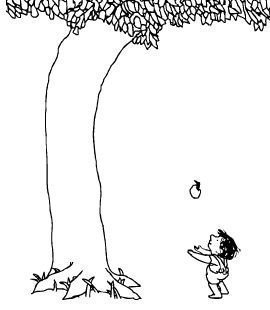
    In Shel Silverstein’s epic tale on gratitude (The Giving Tree, 1964), a talking tree and a young boy age together. Their paths cross at various points and at each one the tree gives generously and is ‘happy’ while the boy, perennially in want, returns only out of discontent and is thus eternally ‘unhappy.’

    The book finds its ending with the tree happily reduced to a stump and a grumpy old man seated on top. My cynical side says it’s the ultimate tale of codependency.

    However, what has made this book a classic is its entertainingly simple pronouncement of ‘the Good News’ – that the life lived in generous, self-giving produces joy of the kind that even a self-interested lumberjack can’t take away.

    After all, Jesus was killed for crimes he didn’t commit, to help people who didn’t like him, become aware of what they really wanted: God and love.

    And we become like Jesus when we embrace inconvenience, discomfort, insult, and unselfishness in order to help others find what they really want: love and God.

    No one wants us more contented and fulfilled than God. And God’s way of doing this was to come down from heaven and be the ultimate example of what brings us the most fulfillment life can offer: self-giving sacrifice.

    How are we being asked to move in that direction? In what ways can we reach out and give? Be inconvenienced? Uncomfortable? And prepared to more deeply fulfill the needs of others? In doing so, we will find out we are the ones who are most deeply fulfilled.
  • God is Nothing


    Go ahead, raise the dead.

    Become the person to whom billions pray.

    Be the most popular man whoever lived (without a dime to your name or a name worth a dime).

    Go ahead, you’ve been dared.

    Our inability to follow suit has nothing to do with the wondrous potential we have as humans and everything to do with the power, omniscience, and otherness of God; of God to be nothing.

    Nothing, as in no-thing.

    For God is no thing, God is not animal, vegetable, or mineral. He defies category, definition, and prediction. If Easter tells us anything it’s that God is far above, far beyond, yet mysteriously interested in loving it all.

    Easter bucks our human tendencies to make God a thing, often in the form of a lifestyle, habit, hobby, IRA, or relationship.

    Easter not only asks us to name our Gods, but to hold tightly to the no-thing-ness of God in a way that frees us from earthly tethers and re-awakens us to the possibility that our partnership with the Almighty might take us to places far beyond our most vivid thoughts, dreams, or earthly abilities.

    This Eastertide let us look beyond things and unto God, clearing out, making order, and re-discovering that our best selves really do dwell in a God who is no-thing.
  • Facing Death


    John Updike famously wrote that, “Each day, we wake slightly altered, and the person we were yesterday is dead, so why … be afraid of death, when death comes all the time?” 

    The death of a relationship, a life-phase, a career, limb, or loved one - yes, Updike is right, we face death every day.

    Holy Week is an invitation to recognize the deaths around us, seeing them not as ends in themselves, but as the beginning, or at least the opportunity to begin anew.

    As we move together through the week ahead let's ask God about the things that need to be put to death.  What needs to go in order that something new may come? What needs to stay and be rekindled? In what ways can we recognize our transitory state in life, see how death routinely visits us, and make peace with our own mortality?
  • Coronation


    When I walked across the stage after four years of university study I did not want to be handed my diploma by a homeless man.

    I wanted the university president, the dean, or a member of the board of trustees. After all I had spent a lot of time, energy, and a boatload of my parents’ money to get there. Didn’t I deserve to receive my certificate of readiness from someone of accomplishment and high position?

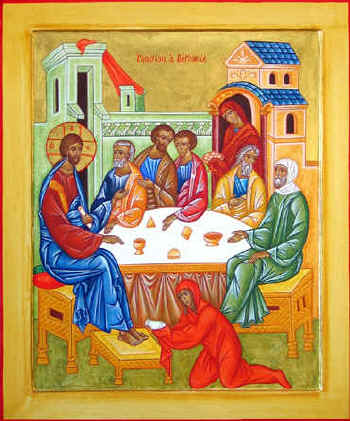
    When Christ our king was famously anointed for his work, an act usually performed by a pope, prince, or other male, the chosen vessel of coronation was none other than a peasant woman. It was Mary who poured a pound of costly perfume all over his feet.

    This anointing becomes an act of liberation not just for the ‘least of these’ but for you and me as well. Rich as we are, at least in comparison to the sustenance living of Mary and Jesus’ friends, we do well to consider the our God desires the poor to be liberated from their poverty just as much as he desires the rich to be liberated from their possessiveness.
    As you and I head into the fifth week of Lent, and our shared work of making order among our stuff, we may have discovered several areas of surplus. We may also have ruminated over the possibility that much of the world has too little because much of the world has too much.  ‘The poor’ are not easily categorized objects of pity, rather God desires the under-resourced and the over-resourced to meet together around a circular table of our shared humanity with Christ in the center. How is our shared Lenten work awakening us to the plight of those who have less? In what ways are we discovering that God has given us much so that we might share with those who do not have as much?
  • Beyond Compare


    I was recently tasked with evaluating an executive.

    During our conversation he paused to thank me for taking the time to offer constructive feedback. He said that, like most executives, he spent an inordinate amount of time and energy worrying about whether or not he was pleasing the board. And this was time and energy he could have spent working at his job.

    There are many things you and I do that sap our resources and take them away from doing the creative and imaginative work we’re called to do. One of the most obvious is comparison.

    This Sunday we’ll hear the popular story of the Prodigal Son, that wayward youngest child who took an early inheritance, squandered it, then returned only to be accepted by his father and mocked by his older brother.

    While we often emphasize the love of the father in this story, there’s no discounting the heap of misery the older brother endured as he mired himself in comparison. He could not stray far from envious and jealous thoughts that bound him like a straightjacket.

    The biggest problem with comparison is that it saps the energy we were given to create. Comparison is toxic. Let it go. Think about something else. The world desperately needs our energies channeled elsewhere.
  • Total Pageviews

    Search This Blog

    Blog Archive

    Powered by Blogger.
    ADDRESS

    St. David's Episcopal Church, 16200 W. Twelve Mile Road, Southfield, MI 48076 USA

    EMAIL

    chris@stdavidssf.org

    TELEPHONE

    +011 248-557-5430