Chris Yaw

I am a Christ Lover

Chris Yaw

Welcome! I’m an Episcopal priest serving a congregation in Metro Detroit... With a passion for gun safety... A zest for online Christian formation... A zeal for video blogging... A budding writer... A heart for those who have unintentionally harmed... A commitment to workforce housing... A love for marrying people... And a wonderful wife, three kids, and a cat... If we have common interests or not, I'd love to connect with you.

Me

Contact Details


  • St. David's Episcopal Church, 16200 W. Twelve Mile Road, Southfield, Michigan, 48076, USA


  • +011 248-557-5430


  • chris@stdavidssf.org

St. David's

I have served as rector of St. David's Episcopal Church in Southfield, MI for 16 years, join us Sundays in person or via zoom.

Disarmory Ministries

Working on the issue of unwanted gun disposal, we've made some real progress in helping rid the U.S. of unwanted firearms.

ChurchNext

Since 2013 we have been helping people learn more about faith through our online learning courses at ChurchNext.

Oakland Housing

Helping middle income families get better housing is a challenge that Oakland Housing has been addressing for 75 years.

Hyacinth Fellowship

Because hurting others hurts us, the Hyacinth Fellowship organizes support groups and reminds us that we are not our worst mistakes.

Yaw Wedding

I have been officiating for more than 20 years and continue to find joy in helping couples build lifelong relationships.

0
U.S. Guns Produced Today
0
Americans Accidentally Killed Today
0
Homeless Americans
0
Weddings Performed
  • Getting Through the Pain


    For anybody who is in pain, worried about experiencing pain, or concerned about someone who is currently in pain – few things grab our attention more than the possibility that our pain can be taken away.  Physical pain, mental anguish, stress, grief, worry - they all count - and we’re all experiencing one or more of them right now. It causes us to ask the usual questions: Why me? Why now? What next? What For? And maybe, Who’s next?

    So this pain often overtakes our world. It can seem like every movement, thought, and passing moment further envelops us in an endless fog of hurt - is that as true for you as it is me?

    Maybe that’s why Jesus spent so much time healing.

    This Sunday we’ll hear about two instances - a young girl and an older woman whose suffering had consumed their lives. One had to crawl through a crowd to get to Jesus, the other had flat out died. And in each instance, Jesus restored the patient to full health.

    It is in stories like these, for there are many in the Gospels, that you and I see that healing brokenness is one of God’s major concerns - perhaps God’s biggest concern. What if we were asked to move beyond the ‘Why me?’ and ‘What for?’ questions and consider the bigger picture - that they speak of God’s deep desire to reconcile and heal a broken world with and to the Love that created it?

    And while we sit here, mired in our own worlds of hurt, we consider the challenge not to make these stories all about us - and consider the possibility these stories are really meant to point us to others. For we know that getting our eyes off of ourselves and caring for others is the very best way to relieve our own pain.

    So, who is hurting around us? Where is the pain in our circle of influence? How might we better identify and address the pain in our communities and world - and become Jesus’ healing touch for them?
    -----------------------
    Reading
    The Guns of August - Barbara Tuchman
    Drive - Daniel Pink
    The Challenge of Adaptive Change - Ronald Heifetz
  • Surviving Storms


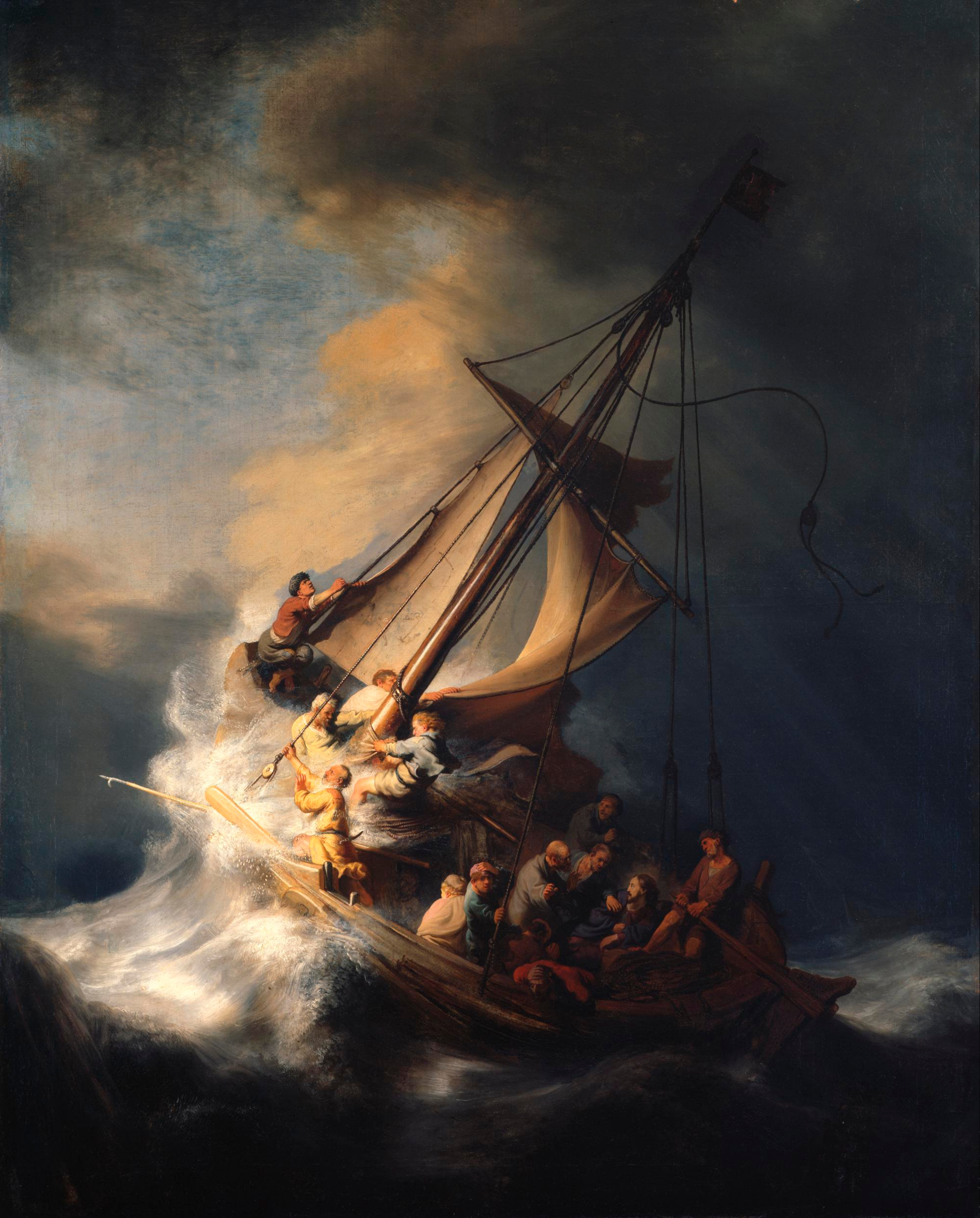
    The painting is called ‘The Storm on the Sea of Galilee’ by Rembrandt van Rijn. And this is about as close as we’ll ever get to it.

    In March of 1990, a group of art thieves walked into the Isabella Gardner Museum in Boston, outsmarted the guards, and made off with a half a billion dollars worth of paintings, making it the largest single property theft in recorded history.

    The painting is notable in several ways. It’s Rembrandt’s only seascape. It contains 13 disciples, not 12. And the one in the cap toward the bottom is widely believed to be Rembrandt himself. (Click here for a larger version)

    While the debate’s still on regarding the religious devotion of the famous Dutch painter, he certainly displays theological acumen here, by placing himself right where the storyteller wants us to be – in the boat with Jesus.

    This Sunday we will hear the full story in Mark 4, about the voyage across the sea in which Jesus fell sleep while the great storm broke out around Him, sending his disciples into a panic. This is when the 12 came asking, "Teacher, do you not care that we are perishing?" – which is a derivation of the questions we often ask God when the world around us is crashing in. We too mistake God’s lack of action with God’s lack of affection.

    However, this story isn’t about the need to wake God up as much as it is about the deep trust that we are to put in God.  It’s a peace so profound it allowed Jesus to dose off. So the moral of the story isn’t, ‘run to Christ when we’re in trouble and He’ll make it go away,’ but, ‘run to Christ so we might learn the source of His calm.’

    Where do you find this calm? What does it feel like? How might we seek it, more diligently, in the week ahead?

    ----------------------------
    Reading
    Drive – Daniel Pink
    Teaching as a Subversive Activity – Neil Postman
    The Guns of August – Barbara Tuchman
  • Spiritual Life Need a Personal Trainer?


    My friend Todd has a personal trainer.

    Three times a week, he stops by the gym and is put through a rigorous workout that includes all sorts of exercises that condition and buff his body into the kind of frame he desires. Todd is a very smart, busy man who relies on his trainer to put together the right kind of program to help him grow and develop.

    One day after a workout I asked Todd, “Does your trainer show you a lot of different kinds of exercises that are more effective than the ones the rest of us do?” “No,” said Todd, “the main reason I have a trainer is not because of what he teaches me, but of how he pushes me. I know how to do all the exercises, I just need help doing them.”

    Isn’t this spiritual life a bit like this?

    In this Sunday’s Gospel we are given a couple of parables that cut to the heart of what Todd is up to. They are stories taken from the agricultural context so familiar to the original audience, which point to the idea of growth – and the importance God puts on the development and advancement of our spiritual lives.

    It’s been said that the faith life of the average North American Christian has developed little since Sunday School. Polls that test biblical literacy seem to support this (my favorite: 1 in 10 Christians believe Joan of Arc was Noah’s wife). This sense that our spiritual lives should take precedent over the development of our physical bodies or our careers is not widely shared both in the culture or in the Church.

    It is poignant that Jesus did not spend much time showing us how to be physically fit or how to climb the corporate ladder. He commended us to pay the highest attention to our spiritual lives – knowing this would lead to the most fulfilling and satisfying life of all.  Yet we know we live in a culture that actively works against this. Indeed, growing more deeply into discipleship is life’s most difficult endeavor.

    So do we need a personal trainer? Or some other regimen that allows us to take our spiritual lives as seriously as we take the development of other areas of our lives? What might a concrete step toward deeper discipleship look like? Is summertime a good time to experiment?

    As your pastor - a reminder that regular visits to the spiritual gym are recommended, and personal trainers are always on hand to assist.

    Reading
    HHhH – Laurent Binet
    Teaching as a Subversive Activity – Neil Postman
    Mark – NT Wright
  • In Defense of Suffering


    In the classic novel ‘Hypatia,’ a highly intelligent pagan found himself fleeing a war zone.  He hitched a ride on a boat manned by Christians, who were spiriting away a cadre of injured soldiers. At first, the pagan mocked the Christians. He found their theology illogical and primitive. Yet during the course of the 3-month voyage the pagan began to change, until finally he launched into a memorable speech, “While I still find much of the Christian faith mysterious and even nonsensical, I am utterly taken aback by what I have witnessed.  You Christians have tirelessly tended to these sick men. They woke you in the middle of the night, and you comforted them. You handled even the most unreasonable demands with kindness. You have deprived yourselves of food so that those without might have something to eat. I have never seen such love in action, such intentional suffering for the sake of others, and I too, fear that the call of the Galilean has a grip upon me.”

    The history of Christianity shows us few times where more progress has been made than those instances in which great suffering has been involved. Across Christian history, and in our personal histories, suffering often leads us to God, and can lead others to God as well.

    In Sunday’s Gospel we find Jesus suffering. He is under assault from fans who want healing and foes who want Him stopped. Jesus suffers the exhaustion and anguish of trying to please everybody, along with the ceaseless anxiety that a pursued deer must feel in the hunter’s crosshairs. Yet through Jesus’ suffering the whole world benefits.

    Yes, we each have our own sufferings. Some we have willingly undertaken, others we had absolutely no say in. And as we study how Jesus moved through suffering, not avoiding it or causing it to disappear, we see that He simply walked in and through it, encouraged by the notion He was doing what He was supposed to do.

    As you and I move through our own sufferings we note that God does not promise to take it away from us either. Instead, God promises to be with us – through it all. For God uses suffering, for us, and for others. How are our present sufferings shaping us and the people around us? How is God using our suffering to further the mission of peace, reconciliation, and healing? Might we, too, bear our best witness when we walk with strength through adversity?

    --------------------
    Reading
    HHhH – Laurent Binet
    Unbroken – Laura Hillenbrand
    Teaching as a Subversive Activity – Neil Postman
  • Lord of the Dance


    In the movie Saturday Night Fever, John Travolta played a young man named Tony from a working class Italian family searching for his identity. With few marketable skills, pressure from his family, too much free time, and a cadre of trouble-seeking childhood friends, Tony needed an outlet. This, he famously found on the dance floor, striking the infamous pose we’ve all imitated. In fact, Tony said one of the only times he ever felt worthwhile was when he was dancing.

    We don’t have to be John Travolta to experience what comes upon us when we do the same thing. Every weekend, countless nightclubs pulse with the sound of dance music. Sure people come to hook up and drink, but they also come to dance. Whether at a disco, bar, or wedding reception, there’s just something about dancing that most of us love. Getting lost in the dance is to go to a place where we can forget the troubles and worries around us. We close our eyes, move to the music, and can be carried off and carried into a frightfully intimate and happy place.
      
    This Sunday is Trinity Sunday. It is the day we attempt to describe God.  For some of the ancient church fathers, God was often explained as a dance. The ten-dollar word is perichoresis. This is the idea that Father, Son and Holy Spirit are an eternal dance of joy that is continually inviting others to join in.

    Imagine if God was that place where we are truly able to let go of our problems and worries. Imagine if God was a place where true intimacy is found. Imagine if God was that frightfully happy place for whom we most deeply yearn. Yes, Jesus is the dance. How might we better lose ourselves in Him?

    ----------------
    Reading
    Unbroken – Lauren Hillenbrand
    Made to Stick – Dan and Chip Heath
    The Book Thief - Markus Zusak
  • God Is Really Real!


    When I was in high school, my friend Tom and I regularly visited a music venue known as Pine Knob where we made extra money buying and selling tickets to rock concerts. We would stand outside the gates offering to buy surplus tickets from guys who’d been stood up or gals whose friends had been grounded, before turning around and selling these tickets for a few dollars profit – just enough to pay for our own tickets and, of course, a beverage of choice.

    Nearly every time we did this, at least one person would offer to sell us ‘Backstage Passes.’ Yes, these were exclusive tickets that always came with a hefty price tag and looked like they had just been run off some Xerox machine. So we always balked on those suspicious offers. Except that one night, when a little known British band was in town, and a couple of young men with English accents, claiming to be roadies looking for beer money, gave us the opportunity to relieve them of their backstage passes on the cheap.

    Since Tom and I had made our money for the night, we figured we’d take the gamble and give these roadies the chance to complain about how watery Budweiser was, as we exchanged cash for their passes and went in to the show.

    About halfway through the concert, which we enjoyed far away from the stage, my friend Tom looked over at me and said, ‘This band is really amazing! Remember those backstage passes?  Let’s go see if they’re real.’ So we flagged down the closest usher, who pulled out his trusty flashlight, examined both sides of our passes, then straightened his appearance before saying, ‘Oh yes, these are real, come with me gentlemen’.

    As we followed that usher I couldn’t help but be overcome with excitement, ‘Wow, look where we’re going, those roadies weren’t lying, we’re going to meet this band, these backstage passes are real!’

    Pentecost is a bit like this. 

    It’s when we remember that the promises of God are real.

    The God those early disciples read about in the Bible, heard about from their friends, and felt most deeply in their hearts – showed up in a rushing wind and tongues of fire - that God, is real.

    Many of the troubles you and I experience stem from our difficulty in living into this reality. We worry about money, job security, medical challenges, and relationship issues – that ask big questions of our faith: will God take care of us, will we be remembered, is everything really going to be OK? The Pentecost answer is, ‘yes’ – we have not been forgotten, we have not been abandoned, this whole Christianity thing is the real deal.

    Pentecost says don’t be bogged down with life’s anxieties, be buoyed with the reality of God’s presence; the One that’s promised in the Bible, witnessed to by the Eucharistic community, and that we feel in our hearts.

    So how can we live more deeply into these promises today? How might we more completely trust in the pledges God has made to you and me? Given God's presence in our lives - how can we use this assurance to better reach out to the world around us?


    Reading
    Made to Stick – Heath Brothers
    Becoming a Blessed Church – Graham Standish
    The Book Thief – Markus Zusak
  • God Cannot Not Love You


    I have friends who believe that terrorists flew planes into the World Trade Center because of the abhorrent sexual behavior of Americans.

    I have friends who believe that they can do things that will separate them from the love of God.

    And I have a feeling both of these are connected; both assume that God reacts punitively to our bad behavior.

    In this Sunday’s Gospel we see something different.  We hear Jesus praying for his disciples. It is a heart-touching petition in which Jesus pleads that they’d be kept safe from harm and be able to experience the deep joy of God. Jesus is surely aware of what will soon come – Peter denying him and the rest of His disciples abandoning Him. Are there worse sins than these? Yet, in spite of their sin, past, present and future, Jesus is steadfast in his allegiance to them.

    And Jesus is steadfast in His allegiance to us.

    One of the more difficult notions for you and me to get our heads around is that God loves us in our sin. Sure, we, and the whole world, would be better to stop sinning, but it will never separate us from God. God is not a punisher. God is not a leaver. And Jesus’ ministry, in which He steadfastly prays for those who follow Him, continues to this day. This suggests there is no one who is more firmly rooting for you and me than Jesus.

    By all means, quit sinning – now. By all means, embrace the reality that God is not (and cannot) love you any less because of your behavior. God cannot, not love you. That’s God’s job.

    In what ways do we need to get rid of the guilt and relax in the knowledge that God really is on our side?

    Reading
    Made to Stick – Heath
    Rome and Jerusalem – Goodman
    The Gospel of John - Raymond Brown
  • Abide, Abide, Abide!


    Once upon a time, when Noah and his ark were adrift on the floodwaters that covered the earth, the animals began to get restless. Life had gotten monotonous. So a contingent of animals came to the skipper and said, ‘Hey Noah! We’re bored! There are no newspapers, the cable’s out, and Gameboys haven’t been invented. When are we finally going to get there?’ Since Noah had no idea how long the trip would last, and because he felt sorry for the animals, he decided to organize some classes.

    One of the classes was on earth science. Animals of all shapes and sizes signed up – even the fish. It was in this class that the fish first learned that in order to survive, they needed to be in water. The fish had no idea that this was the case. And so the other animals began making fun of them, calling them Wetbacks and Waterboys. So after class, the fish quickly swam home and said to their mother, ‘Mom, Noah taught us that since we’re fish, we need to live in water! The other students said we were already wet! Where did this water come from, and what do we need to do to get it?’

    Their mother leaned back and laughed. In a soothing voice she comforted her children saying, ‘My dear ones. You have lived your entire lives underwater. Water is all around us. You don’t feel it because you’re so used to it. You don’t know about it because you’ve never been out of it. So relax, go do your homework, and don’t forget to use the waterproof ink.’

    One of the grandest and most forgotten truths of Christianity is that God is all around us – above us, below us, and in us. Like fish in water, there is nowhere the Living Water is not.

    In Sunday’s Gospel we hear Jesus make this clear, declaring that He abides in us. For you and me, this is something that has been going on for so long we no longer pay it much attention. The presence of God is so consuming we totally lose track of it.

    This can be good and bad.

    At times we feel lost and abandoned. We feel lonely and afraid that God has left the building. We feel like we need something outside of ourselves when what we really need is already there.

    But we can also take heart that as He abides in us we can abide in Him. Yes, there is a difference. While God’s life in us is a matter of fact, our life in Him is up to us. Jesus adjures us to abide, abide, abide in Him!  Pay attention to His presence in us. Stay connected so that we might do the works of love, peace, and reconciliation that He has lined us up to do.

    Of course, Jesus never leaves us – He is in our hearts to stay – but we choose the distance between us. How close are we? Do we need to draw closer? How will we go about our task of abiding this week?

    Reading-
    Poured Out, Filled In – Mark O. Wilson
    Rome and Jerusalem – Martin Goodman
    Hypatia – Charles Kingsley
  • Witnessing to Peace


    In the common room of a ward for adults suffering from psychiatric afflictions, a patient recently got up and proclaimed, ‘I am Jesus Christ!’ Now messianic thoughts like this are not uncommon among this population, so no one paid much attention. That is, until a second man stood up and said, ‘I am Jesus Christ!’ Then, just as the supervisor began to take notice, a third man stood up and proclaimed, ‘I am Jesus Christ!’ All three, then, began to debate. As the argument rose in volume and intensity the quick-thinking supervisor jumped to her feet and separated the three, then instantly restored calm by declaring, ‘This argument will be easy to settle because, as we all know, Jesus’ was best known for preaching peace.’

    “Jesus #peace” is the main identity you and I will encounter this Sunday when He appears (for a second Sunday in a row!) to a roomful of startled disciples. You and I note that He doesn’t condemn them for their fear, but accommodates them. Instead of berating them for their nimble faith, Jesus offers proof that He is who He says He is, then declares that repentance and forgiveness will be proclaimed by this group, whom He declares as His “witnesses.”

    Sure the word ‘witness,’ used in a religious context, might frighten us. We conjure up images of open-air preachers insulting passers-by and weirdoes handing out literature in public places. But then we remember how we ‘bear witness’ to people all the time. Many of us can’t shut up about great movies or new TV programs, killer clothing stores, snappy websites, and clever smartphone apps.  Actually, we ‘bear witness’ all the time - telling others about the things that matter to us.

    Bearing witness, then, as Jesus seems to suggest, is little more than talking about where we sense God at work. It is about sharing the things that are important to us - telling others about how we observe God operating in our world. Witnessing is not an act of persuasion, it is an act of peace – remember, Jesus #peace.

    So, where is God at work in our lives? What are our ‘God moments?’ Do we talk about them? Not to sound ’religious’ – but as a natural part of who we are – who we want to be – or who we’re called to be?

    ----------
    Reading
    Jerusalem and Rome – Martin Goodman
    Hypatia – Charles Kingsley
    Making Sense of Scripture - David Lose
  • Stuck in a Rut?


    Ever wonder why we can’t get out of this rut?

    Maybe it’s a question you’ve asked as you went to the same job, in the same place, after leaving the same house and the same family so often it feels like life has no more zest. Why do I feel stuck, wedged, and jammed into a slot that’s getting more and more uncomfortable?

    Feeling stuck is often an ironic result of lives constructed to help us feel the opposite. We crave freedom and fulfillment, often as a product of our deepest fears around security, abandonment, and acceptance. These fears can often be at the heart of the big choices we make surrounding work, home, and family. And as we construct lifestyles to assuage these feelings we build frameworks, habits, and traditions that form ruts.

    This Sunday, we meet a disciple who’s in a rut. His name is Thomas, as in doubting Thomas – the one who refuses to believe the news the Jesus has risen unless he can see and touch Christ’s wounds. What keeps Thomas back seems to be his presuppositions about who God is and how God is supposed to act. Thomas is unwilling to abandon his framework for understanding faith and God. The result, ironically, is that the love he so desperately craves, is unrecognizable and unembraced. He is forever branded a doubter, and despite his subsequent recanting and acceptance, he becomes known for his wavering faith.

    Thomas was apparentely focused on a conception of God that was undoubtedly safer and more comforting – and which would have only led to his ultimate insecurity and suffering had he continued to reject the One who so desperately pursued him. As Paul Tillich has said, faith is the courage to accept acceptance.

    So what’s holding us back? How is our priority on self-preservation actually depriving us of the self-fulfillment we more deeply desire? Why are we allowing our mediocrity to trump our possibility? And what do we need to take a chance on today?

    ----------
    Reading
    Hypatia – Charles Kingsley
    Seasons of Faith and Conscience – Bill Wylie Kellerman
    Drive- Daniel Pink
  • The Judas In Us


    On Holy Wednesday our Gospel takes us to that epic scene of Judas' last supper with Jesus - and this disciple's turn to 'the dark side' - as St. John puts it: 'after receiving the piece of bread from Jesus, Satan entered Judas.'

    It is downright scary to imagine Satan entering anyone. Was Judas predestined to be the Christ betrayer? Does God choose certain people to be really bad? Does God abandon people like serial killers, to their own twisted desires and intentions? And how does this square with a God of 'love?'

    Yes, a popular answer is to make all evil God's responsibility - after all, God's in charge, right? Therefore, God is responsible for creating us this way, God is responsible for indoctrinating us in this way, and God is responsible for bringing about the circumstances for our temptation toward evil so that we can, nice and neatly, avoid culpability. Hmm...

    Yet we suspect it's not that easy. 

    We know that to love is to grant freedom. In God's great love for the world God allows us determination in our own destinies. We can make choices. We can bless and we can curse. The extremes lead to unbelievably loving words and deeds, and unspeakable horrors and atrocities. We suspect there is always a human element involved in rendering great good and great evil.

    However, lest we expend all of our limited resources parsing these questions of theodicy, Holy Wednesday also calls us to identify - for you and I are also Judas. We have our moments of betrayal. We have turned our backs on Christ. Sometimes I wonder if the only difference between me and Judas is that he gets better press.

    Yes, Holy Wednesday asks us to ponder the Judas in each of us, which is not intended to breed guilt and condemnation, rather humility and understanding for those around us when they act a bit too Judas-y. How might we better understand those hurting us as not alone in their ability to wreak havoc on others - for we can do the same thing?
  • What Is It About God's Love That We Crucify It?


    “Then Jesus gave a loud cry and breathed his last.”

    What is it about God’s love that we must crucify it?

    Here He came, with nothing but unadorned affection for the Creation He had made out of his own hands and declared, ‘It is very good.’

    He arrived in the most unassuming way, demanding neither taxes nor tribute – just the natural affection everyone has for a suckling infant.

    He loved us unequivocally.

    And we received Him with great joy. Flocking to hear His sermons, watch His miracles, and get healed from our most desperate afflictions.

    We waved palm branches and cheered at His triumphal entry into our hearts – for we had never felt so secure, so loved, so complete.

    Yet the over-abundance of love – non-judgmental and unearned – seemed to overwhelm us with possibility: how might we profit from this, financially, socially, politically?  And we paid little attention to love’s vehicle, which is also love – and our own inability to simply receive God’s love became apparent.

    This is how we crucified love.

    Perhaps our greatest struggle, then, is not with sin, but with accepting God’s love – receiving the love with which God loves us.

    This Sunday, as we hear the Passion of the Christ unfold, we will ponder the notion that the cross is not simply the place where the darkness of sin is dealt with – but it is also the struggle we all have of unambiguously accepting God’s love for us. Sure, the cross is about redemption, but this is not our starting point: it is not, ‘For God so judged the world…’ it is ‘For God so loved the world…’

    -----------
    Reading
    Choice, Desire, and the Will of God – David Runcorn
    Seasons of Faith and Conscience – Bill Wylie Kellerman
    Matterhorn – Karl Marlantes
  • Total Pageviews

    Search This Blog

    Blog Archive

    Powered by Blogger.
    ADDRESS

    St. David's Episcopal Church, 16200 W. Twelve Mile Road, Southfield, MI 48076 USA

    EMAIL

    chris@stdavidssf.org

    TELEPHONE

    +011 248-557-5430