Chris Yaw

I am a Christ Lover

Chris Yaw

Welcome! I’m an Episcopal priest serving a congregation in Metro Detroit... With a passion for gun safety... A zest for online Christian formation... A zeal for video blogging... A budding writer... A heart for those who have unintentionally harmed... A commitment to workforce housing... A love for marrying people... And a wonderful wife, three kids, and a cat... If we have common interests or not, I'd love to connect with you.

Me

Contact Details


  • St. David's Episcopal Church, 16200 W. Twelve Mile Road, Southfield, Michigan, 48076, USA


  • +011 248-557-5430


  • chris@stdavidssf.org

St. David's

I have served as rector of St. David's Episcopal Church in Southfield, MI for 16 years, join us Sundays in person or via zoom.

Disarmory Ministries

Working on the issue of unwanted gun disposal, we've made some real progress in helping rid the U.S. of unwanted firearms.

ChurchNext

Since 2013 we have been helping people learn more about faith through our online learning courses at ChurchNext.

Oakland Housing

Helping middle income families get better housing is a challenge that Oakland Housing has been addressing for 75 years.

Hyacinth Fellowship

Because hurting others hurts us, the Hyacinth Fellowship organizes support groups and reminds us that we are not our worst mistakes.

Yaw Wedding

I have been officiating for more than 20 years and continue to find joy in helping couples build lifelong relationships.

0
U.S. Guns Produced Today
0
Americans Accidentally Killed Today
0
Homeless Americans
0
Weddings Performed
  • The Palm Sunday Marathon


    Palm Sunday is the longest service of the year. The procession is long, the readings are long, and the liturgy is long. Yet year in and year out you and I find ourselves right here, preparing for the marathon. We don’t take shortcuts. We don’t shorten it. We don’t condense it. We don’t edit it. We clear our minds, weed out the distractions, and open our hearts. We become truly present.

    We take a deep breath and let this story – this living story - breathe new life into us - for we are about to enter into the most momentous events in human history.

    In Word and Sacrament we will witness:

    -The Institution of the Eucharist
    -The Dispute over who’s the Greatest
    -Jesus’ Prayer at Gethsemane
    -Judas’ betrayal and infamous kiss
    -The Trial Before the Jewish High Priests’
    -St. Peter’s Denial
    -The Sentencing by Pilate
    -The Crowd demanding crucifixion
    -Jesus’ excruciating Walk with the Cross
    -The gruesome Crucifixion
    -The Thief on the Cross
    -The Centurion’s Admission
    -The Burial by Joseph of Arimithea

    This is a story that’s changed lives. This is a story that’s changed our lives. This is a story that wants to change us today. What are we bringing to the story this year? Which aspect of this tale will speak to us? How will we be shaped even more into the Cruciform image we so desire? We don’t know. But we do know that God is at work -and all we need to do is to be present.

    Reading
    The Heart of Christianity - Marcus Borg
    A Story of Shalom - Philip Cunningham
    Understanding Poverty - Ruby Payne
  • A Great Gift


    Perhaps the most significant gift our parents give us is a general outlook on the world - a structure for how things all come together, a worldview, if you will, that serves as a foundation for the way we view everything else.

    Marcus Borg likes to say that we generally inherit one of three paradigms. The first is the idea that the world is a scary and frightful place. Reality is hostile, death will get us, we must be about protecting what is ours and safeguarding all that is precious. How do we respond to life? Defensively. We are wary of new ideas and hold fast to the time-tested and familiar.

    A second view is that the world is indifferent and without care to its surroundings. Life is random. There is no final purpose. All that we are and see are the results of evolutionary accidents. In this world we think mostly of ourselves, grab what is ours, live for the moment, fulfill our needs without undue care for that which is outside the immediate and the accessible, or what will happen to and for those who will come after us.

    A third view, and the one I am most thankful to my parents for passing on to me, is that reality is gracious. All that surrounds us is potentially nurturing and life-giving. Wonder and beauty speak of a purpose to life and a deep meaning to reality. We can let go and jump into the fray because we know that we are held. We can seek adventure and take risks knowing that it will all somehow be OK. We can approach life like a survivalist who falls into quicksand: relaxing and letting the bog carry us, knowing that if we flail about gripped by fear, we will surely die.

    Which paradigm do we lean towards?
    Which paradigm do we want to lean towards?
    Which paradigm are we passing along to our children?
  • Drawing Nigh Unto the Poor


    How we treat the poor is how we treat God.

    It’s the plain message of Matthew 25, much of the Gospels as well as a strong theme of the Old Testament. If we want to see the human face of God, we have to look no further than the, ‘least of these.’

    During Lent many of us try to draw closer to this Bible truth, in almsgiving and increased volunteer work. Together we look for new and deeper ways of identifying with the plight of the poor. While this might sound altruistic and ‘other centered’ the real beneficiary in all of this is us.

    What’s your attitude toward the poor look like?

    If you’re like me, you rarely think twice about clicking past a TV ad drumming up aid for the hungry, telling a beggar on the street, ‘No thanks,’ or even tossing out letter after letter of ‘urgent appeals’ that I find in my mailbox each week. I am not happy with myself when I do this and I know that the conditions of modern life can callous my heart to the degree that, as Thomas Merton once put it, I no longer have possession of it. I can become unable to have my heart broken by all the starving children, their distraught and helpless parents, not to mention countless earthquake victims.

    Then there’s my competitive way of living that can draw my focus toward my own strategies and gains and far away from the dire needs of most of the rest of the world. The swift and varied gales of change keep me preoccupied and diverted.

    A tortoise shell heart and a distracted mind are not the most helpful accoutrements of a budding disciple. They keep me from following the path of Christ. I am no longer fully human or fully alive.

    In John 10 we hear Jesus talk about his mission to bring humanity, ‘life and life more abundantly.’ That abundant life is all about fulfilling our humanity. When we tend to the plight of the poor we reclaim that part of us that has calcified and we bring our attentions round front and center. And we discover anew that in the face of the poor, we see God, and thus are made new again.

    We know this instinctively. Psychologists will often recommend that the depressed seek out some sort of volunteer activity, that they move the focus off of themselves and onto an area of need. Now that Easter has come, we have accepted this new light of the resurrection, how can we too move forward like those early disciples in continuing the work of Christ? How might we be called to answer the cries we are now that much more familiar with? How might we use our newfound humanity to fall deeper in love with the Christ we see in the faces of the poor?


    Good Reads
    The Politics of Jesus – Obery Hendricks
    The Misunderstood Jew – Amy Levine
    Saving Jesus from the Church – Robin Meyers
  • Coming Home


    It’s no wonder the Prodigal son ever came to his senses. After all, he was returning to one of the most dysfunctional households in the Bible. The mother is awol, the father has less pride and fewer clues than Homer Simpson, the brother treats him like toxic waste, and we can imagine family meals around that house having more drama than a season’s worth of The Kardashians.

    But the money had run out and the hunger had set in. For the Prodigal son, the trip home was out of desperation and not sentimentalism - coming home was his best option. Coming home was his only option. Coming home was the smartest thing he would ever do. Coming home was the hardest thing he would ever do.

    And in this fourth week of Lent you and I are invited to look for the parallels - and the ways we choose avoidance over reconciliation. How many times have we screened phone calls, skipped outings, and filled our lives with distractions rather than facing up to and grappling with forgiveness? Sometimes it’s only when our backs are against the wall and we’re forced to forgive that we finally do. And when we finally do, as difficult as it is, we find that we experience a little slice of heaven.

    Coming Home makes for one huge metaphor. It stirs up uncomfortable relationships and situations we may have buried years ago, but that deep down inside we want to make right. Could this be the time? Is Lent 2010 calling us to ponder the ways we need to come to our senses and make peace with someone else - a family member, a neighbor, a co-worker, a friend, a church, or even God? In what ways are we running, in what ways do we need to come to our senses? In what ways have we distracted ourselves with dissolute living in order to avoid the tough stuff, the real stuff, of making things right?

    Reading List
    Explosive Preaching – Ron Boyd-McMillan
    The Source – James Michener
    The Politics of Jesus – Obrey Hendricks
  • Second Chances


    My wife finally had enough of the kitchen rug.

    It was one of these cheap sisal numbers that we bought at IKEA for about $40. And after a few years of muddy boots, splattered spaghetti sauce, splashed coffee, and drippy chocolate syrup we knew it was only a matter of time before it would take on a life of its own and rise up to greet us some morning.

    So she finally rolled it up and carted it out of the kitchen. It sat on the back porch for a few days waiting for me to put it in the garbage can, but each time I walked past I just couldn’t bring myself to it. What I decided to do instead was put the rug in the garage and wait for spring. I’ll wait for a sunny day, hose it down, take a scrub brush to it then let the sun dry it. I’m sure it won’t go back in the kitchen, but I think I can find a place for it in the basement or at least in the workshop. Sure, the carpet is pretty spotty now, but I think it deserves a second chance.

    Jesus seems to be saying something like this in the Gospel lesson we’ll hear on Sunday. It’s a parable of second chances. In it a man who’s planted a vineyard sees that his fig tree refuses to bear fruit. He orders it destroyed. However the gardener makes an appeal and asks for time to put down fertilizer, pay more attention to it, then, if there is still no fruit next year, he will agree to cut the tree down.

    The gardener sees something in the fig tree that no one else is seeing. It’s potential, it’s possibility, it’s the prospect of a turnaround. Can the underdog, perennially impotent fig tree deliver the goods? Details at 11.

    What’s curious about this story is that 11 o’clock never comes – we have no idea if the fig tree ever bore fruit. What we do know is that getting and giving second chances seems to be something rather important. Is there someone in your life who needs a second chance? Is there some situation happening around us that we need to be more patient with? Is there potential and possibility we are overlooking? How are we being called to give a second chance?


    Reading
    Empire Falls – Richard Ruso
    The Five Most Important Questions You Will Ever Ask About Your Organization – Peter Drucker
    Mountain Reigns – Joe Lacy
  • The Lament of God


    When you worship inside the chapel pictured above, Jesus’ words in Sunday’s Gospel come to life, ‘Jerusalem, Jerusalem, the city that kills the prophets… how I have desired to gather your children… and you were not willing.” The name of this place is Dominus Flavit (‘The Lord Wept’) and it sits across the valley from the Holy City, on a plot of land pilgrims swear Jesus once stood to voice his famous lament in Luke 13. This chapel holds something very important, not just for Holy Land visitors, but for all of us who grieve.

    Every day you and I lament over missed opportunities, unrealized potential, and the crippling reality that things don’t always go according to plan. We scream into the night, ‘Why does this always happen to me?’ and ‘It’s not fair!’ The drama of our lives can seem like it’s played out inside a shaken snow globe, where an invisible hand, subject to unpredictable spasms, exercises complete control over every aspect of our world. And here we are, flopping around inside, trying to hold on to the furniture or at least stand up straight and keep from getting hit in the head by a flying candlestick.

    Sure, on our good days, when the world is settled and all is at peace, we can lean back in our recliners and take it all in – feeling utterly breathless by the glory of it all. And on those days perspective comes as we find places for the joys and the smiles, the disappointment and the lament. Ecclesiastes says there is a time for all of this. And Jesus sounds a New Testament echo by reminding us that we’re not the only ones who grieve. God does too.

    ‘Jerusalem, Jerusalem…’ How Jesus puts words to feelings we all experience when we long for something we cannot get. Or we yearn to protect someone we cannot protect. Or we seek to warn someone who will not listen. It may come as a shock to some of us who believe everything that happens on this earth happens just the way God wants it to. But it is apparent that the imperfection that surrounds us also has a place in God’s economy.

    So as we contemplate the subjects of our own grief we understand that this is not a solitary enterprise. Jesus understands and shares our lament. And, perhaps even more importantly, we remember the balance of life, and how lament will give way to laughter, as the Psalmist says, ‘mourning comes at night but joy comes in the morning.’ For we can never forget that one of the purposes of lament is to lay the groundwork for new beginnings. Something fresh and new will be born. There is death, but there is resurrection.

    Further Reading
    Jerusalem: One City, Three Faiths – Karen Armstrong
    From the Holy Mountain – William Dalrymple
    The Jews in the Time of Jesus – Stephen Wylen
  • Temptation


    At first hearing the story of Jesus ‘temptation in the desert’ sounds about as pertinent to my life as crop yields in the Outer Hebrides. Sure it’s important to somebody, somewhere, but it’s simply too far removed from my time and cultural context to say much to me. Jesus’ dialog with the Diablo sounds more Dickens than Gospel – as the pair seemingly float through a dreamland of time and space from one temptation to another. At least Ebenezer Scrooge got Christmas dinner – Jesus won’t even cave for a loaf of bread.

    Maybe it’s because my biggest temptations don’t seem to be Jesus’. I get angry, frustrated, and worry too much about having enough. I want to honk at slow people in the fast lane and call the manager when a check-out lady opens up a new register and the people behind me get to go first. Why didn’t Jesus get tempted by a telemarketer calling at dinnertime? Or a mechanic who told him he needed a new transmission? Or a corporate bean counter coldly informing him his pension was being cut? Let’s see how Jesus handles those temptations!

    But when I hear this story again and again, as you and I do on every first Sunday of Lent, we begin to see the shades and nuances that make this encounter more relevant than we might think. I begin to see that these temptations really are my temptations.

    They boil down to self-doubt, idolatry and skepticism about the Divine. When Jesus is challenged to make a stone into bread, I too need to deny the impulse to prove myself. When Jesus is offered all the riches of the world if He will only bow down to another, I too need to fight against the desire to make worldly goods my real gods. And when Jesus is asked if God really does care for Him, I too must put to flight notions that God doesn’t care about me either.

    Jesus handles this by actually speaking to each temptation. I have found this a helpful strategy, employing not the same words but the same tactic. With a nonchalant indifference I tell whatever tempting notions that come my way, ‘I simply don’t have time for you.’ Like Jesus, we are on a mission to do greater things, and as we set our sights on those things, we might also see the devil departing somewhat swiftly from us.


    Reading
    How (Not) to Speak to God – Peter Rollins
    Empire Falls – Richard Russo
    Missional Renaissance – Reggie McNeal
  • It's Not About the Fish


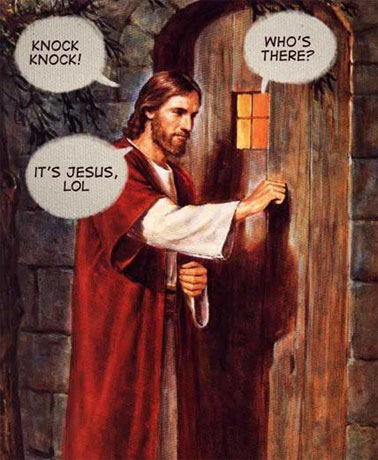
    Imagine going to the kitchen to make chocolate chip cookies and getting out all of the ingredients, only to find the flour tin dead empty! Drat, no cookies. Then, the doorbell rings. It’s Jesus. We invite him in to the living room where we relax and shoot the breeze. “Got any chocolate chip cookies?” He says. “No,” we say, wondering about the coincidence of the question. “Would you please go bake me some,” Jesus asks. “Hmmmm,” we say, “But I’m all out of flour, I just checked.” Jesus pauses for a moment and says “Check again.” Lo and behold, we walk into the kitchen, remove the lid from the flour tin, and find it filled to the brim.

    Or we’re at the office, where we’ve been trying all week to sell the back page of the catalog to a deep-pocket customer named Mr. Smith. We’ve talked to him numerous times, and Smith’s explained that his business is down, he’s cutting budgets and staff, and there’s no way in tarnation he’ll be able to buy an ad this month, or for that matter, for the rest of the year. Then, Jesus walks in. We offer him a chair and start shooting the breeze. “I see you still haven’t sold that back page yet,” he says, strangely familiar with our business. “Nope, it’s bone dry out there,” we say. Then Jesus says, “Why don’t you call Mr. Smith?” Boy, how did Jesus know that I just got off the phone with him? “Funny you should ask,” we say, “I’ve talked with Mr. Smith every day this week and he says he’s in no position to buy.” “Try calling him again,” Jesus says. And when Smith picks up on the first ring we find out that not only is he willing to buy this month’s back page, but he wants the inside cover as well, and a full schedule through 2011.

    Sales inexplicably materializing in the office!
    Flour mysteriously appearing in the kitchen!
    Can we see why St. Peter, in this Sunday’s Gospel reading, did exactly what you and I would have done had our fishing boats all of the sudden starting listing with the weight of all that abundance?

    And when we think about it we understand that this story’s not about fish, or flour, or making sales quotas. It’s about God making God’s self known to us.
    Sure, this was a very impressive miracle, but it was no less dramatic than the miracle that convinced you and me about who Jesus was and is in our lives. Maybe it happened at Baptism, or Confirmation, or an amazing sunset, or when a tragedy struck, or slowly over time when we somehow became utterly convinced that God was with us.

    This story begs us to recall that first miracle that revealed God to you and me. But perhaps more importantly, it also asks us to consider what we’ve been doing as a result. Have we too, ‘left everything and followed Him?’ How have we gone fishing for men? If we’ve really witnessed the miracle of Jesus making himself known to us, then what are we doing with it?

    Reading
    The Glass Castle – Jeannette Walls
    Missional Renaissance – Reggie McNeal
    Rediscovering Values – Jim Wallis
  • When God Doesn’t Act The Way God’s Supposed To


    “I didn’t get the job I deserved.”
    “I didn’t get the car I wanted.”
    “I didn’t get the marriage I prayed for.”
    “And I have been an honest person - law-abiding and God-fearing – yet few of the things I wanted out of life have come my way.”
    “Why, God, don’t you do what you’re supposed to do?”

    After all, what God is ‘supposed to do’ probably dominates our reasonings more than we suspect. Most of us live with an unspoken quid pro quo that if we live decent lives God acts decently toward us. God takes care of the poor and ailing, provides awesome sunsets on starless nights and keeps my family and me relatively safe and healthy because that’s just how God deals with good folk like me.

    However, every once in a while, usually in the most painful times of our lives, our idea that God’s ways are limited to our expectations, simply blows up in our faces. An earthquake, a recession, an untimely death – these are just a few of the things that can turn our theologies into skeletons and leave us vacant and vulnerable.

    When these things happen our first reaction is usually anger. I remember when a relative was diagnosed with a brain tumor. Many in our family were mad. Maybe it was simply anger at the circumstances, but it certainly bled over into our understanding of God. Some of us stopped praying and stopped going to church. We were simply unable to face God until God ‘fixed it.’

    Thankfully, God did fix it, and we all returned to our normal routines. But not before taking a deeper look at the roots of our anger, trying to understand why God acting outside of our predetermined frameworks, could make us so upset.

    Of course, we’re not the first ones to feel this way. In this weekend’s Gospel reading we will hear fierce anger directed at Jesus by his hometown friends when they discovered that he wasn’t the Messiah they thought he should be. Their anger nearly turned deadly had Jesus allowed it.

    And so we ask: How has God defied our expectations? Are we angry about it? Should we be? The secret to living a peaceful life is resisting the urge to put our expectations on the Lord and being open to what each new day and discovery might bring.

    Reading
    Missional Renaissance – Reggie McNeal
    Advanced Strategic Planning – Aubrey Malphurs
    Peter Gomes - Sermons
  • Dream Come True


    "And he rolled up the scroll, gave it back to the attendant, and sat down... Then he began to say to them, "Today this scripture has been fulfilled in your hearing." Luke 4

    The Scripture in question is Isaiah's dream for Israel, the Gentiles and the world. I like to think it's my dream too.

    I dream about sitting in my library, relaxing in my favorite upholstered chair - looking out at the snow-covered back yard as the flakes gently fall, and I quietly sip from my extra-large, piping hot mug of premium, home-made hot chocolate. It’s creamy and frothy and made from chocolate nibs imported from Spain, and I savor every sip, from the lip burning first to the lukewarm last.

    And my dream is this: I want to sip that hot chocolate knowing that there’s not a man or a woman on the face of the earth who can’t have the same hot chocolate. I want to savor that hot cocoa with the peace of mind of knowing that there’s not a sick person in the world who has been forgotten, unable to receive life-giving medicine, and who has easy access to affordable, high quality medical care.

    I want to enjoy that hot chocolate knowing that every innocent civilian living in war zones where bombs are dropping, bullets are flying and terrorists are threatening every minute of their lives. I want to know that these innocent families have been whisked away to an oasis where their doors can go unlocked, their pantries are full, and their children merrily prance through deep green meadows.

    I want to sip that hot cocoa knowing that every stray animal has a loving place to call home - where the violence of abusive caretakers is no more, where a place to sleep is no longer found on the mean streets, and where the threat of being impounded or worse, has vanished.

    I want to savor that toasty mug of hot chocolate knowing that there is not a parched tongue in Haiti - that there is not a re-built building that can ever tumble again - that there is not an orphaned child who has not been vaccinated, educated, ice-creamed, and bed-time kissed before she lays her head down on clean, crisp, cotton sheets for the night. (Peter Laarman)

    And I want to know all of this with such assurance that for the time it takes me to drink my hot chocolate I don’t need to have a thought about anything or anyone except the cooling mug in my warm hand and the person with whom I’ve chosen to enjoy it.

    The 'already but not yet' of Isaiah's (and my!) dream has seen its fruition in Jesus, but it looks for its fulfillment in you and me.
    What are we doing to make our dreams come true?

    Reading
    Advanced Strategic Planning - Aubrey Malphurs
    How (Not) to Speak to God - Peter Rollins
    A Letter of Consolation - Henri Nouwen
  • Helping Haiti


    The biggest natural disaster of the year has hit the country least prepared to handle it.

    Thousands of makeshift homes held together more by faith than proper building materials, simply collapsed at the 7.0 force, slid down mountains or were buried by bigger buildings. The country’s punishing, tire tantrum roads means relief work will be tough. Already spotty water, electric and phone service will make things even worse. Given the nation’s M.I.A. government and authority structures, we’ll probably never know exactly how many people were hurt or injured in this massive tragedy.

    Poor, poor Haiti will spend weeks, even months digging out of 60-seconds of earth shaking. And many will ask, ‘What did this island nation do to deserve this? How could the Lord simply stand by and watch as so many innocent people cried out in pain and suffering? Where was God?’

    Well, according to this Sunday’s Gospel reading, God was at the bar.

    More precisely, and not to be even more flippant, the Lord was tending to another disaster. Sure, it was of much smaller proportion. Running out of wine at a wedding was a social faux pas that, at worst, could lead to communal ostracism and removal from some rather important Christmas card lists - but surely not to loss of life or limb as we are seeing on Hispaniola. This Sunday we will hear that familiar tale of the Cana miracle and remind ourselves that in the face of disaster the Lord is not one to hide or duck out of sight, but is always first in line to spring into action with care, compassion and remedy.

    After all, why did the hosts run out of wine in the first place? Were they cheapskates? Did an unexpected heat wave make people drink more than planned? Did Vince Vaughn bring a band of wedding crashers? All we know is that the party was rocking, and the guests needed more wine. Why poor Haiti, which finds itself ever so unfortunately located at the intersection of Hurricane Alley and Fault Line Way, continues its uphill battle with mere survival, we can only venture theories.

    However we do know that, as so many of us have seen time and time again, Jesus is surely among the first on the scene with a shovel, pickax, band-aid and bottle of clean water. The Incarnation is not the tale of a passive, inactive God. It is the story of One who cares enough to come here and do something, walking by example, healing, raising up, and casting out. And in His physical absence, you and I have been asked to take up the slack. For His hands and feet are our hands and feet. Please give to the charity of your choice and come to the aid of those hurting most. (www.er-d.org. is taking donations for the people of Haiti on its home page. Churches are often much more efficient at disbursing aid in disasters because they already have the buildings and relationships)

    God of compassion and might, who knows how fragile this life is, give all those harmed by this earthquake the knowledge of your abiding presence. Bring healing and consolation to all who suffer, especially ________. Give us faith and courage as we witness the devastation of the rumbling earth and inspire us to take action. This we ask through the One who knows well both pain and death, Jesus Christ our Lord. Amen
  • Lightbulb


    A friend of mine tells the story of his good buddy Lightbulb.
    Lightbulb had a place in the middle of the room where he shone and shone and shone. Every day dozens of people came around him to do important things and to seek the illumination offered by his presence. Lightbulb was also very conceited. He knew he was warm and bright, and he took pride in the very important role he was playing in the world.

    One day someone came to Lightbulb, unscrewed him, and placed him on the table, where he lay, cold and black. Try as he could, Lightbulb could not generate even a spark of illumination. Despite all of his efforts, Lightbulb could not find a way back to the socket where he had spent so many glorious hours. And with every attempt he would make to roll himself off of the table Lightbulb came closer and closer to falling off the edge and destroying himself.

    Poor Lightbulb! He didn’t understand that his capability to illuminate had not come from himself, but from the wires and circuits in the ceiling and the power plant across town. How much more at peace he would have been had he realized that the light he had been able to generate was not his own, but came from a much greater source.

    In today’s Daily Reading Jesus says, ‘I am the light of the world. Whoever follows me will never walk in darkness but will have the light of life.’ (John 8:12) This light, that comes through us in a myriad of ways, from our health to our wealth to our gifts of many, many talents, always tempts us toward pride. How often we puff out our chests at a compliment, think more of ourselves because of the accolades of others, and even think of ourselves as better than others because of the ways this Light comes through us.

    But this light is not of our own making. Every talent, every possession, every second on earth is a gift. Unearned. Undeserved. Unbelievable. Think of one thing that you take pride in. Now trace that talent back to the source. In what ways can we acknowledge that source, give it back to the Lord and accept His peace?

    Reading:
    A Letter of Consolation – Henri Nouwen
    When You Are Engulfed in Flames – David Sedaris
    The Great Awakening – Jim Wallis
  • Total Pageviews

    Search This Blog

    Blog Archive

    Powered by Blogger.
    ADDRESS

    St. David's Episcopal Church, 16200 W. Twelve Mile Road, Southfield, MI 48076 USA

    EMAIL

    chris@stdavidssf.org

    TELEPHONE

    +011 248-557-5430