Chris Yaw

I am a Christ Lover

Chris Yaw

Welcome! I’m an Episcopal priest serving a congregation in Metro Detroit... With a passion for gun safety... A zest for online Christian formation... A zeal for video blogging... A budding writer... A heart for those who have unintentionally harmed... A commitment to workforce housing... A love for marrying people... And a wonderful wife, three kids, and a cat... If we have common interests or not, I'd love to connect with you.

Me

Contact Details


  • St. David's Episcopal Church, 16200 W. Twelve Mile Road, Southfield, Michigan, 48076, USA


  • +011 248-557-5430


  • chris@stdavidssf.org

St. David's

I have served as rector of St. David's Episcopal Church in Southfield, MI for 16 years, join us Sundays in person or via zoom.

Disarmory Ministries

Working on the issue of unwanted gun disposal, we've made some real progress in helping rid the U.S. of unwanted firearms.

ChurchNext

Since 2013 we have been helping people learn more about faith through our online learning courses at ChurchNext.

Oakland Housing

Helping middle income families get better housing is a challenge that Oakland Housing has been addressing for 75 years.

Hyacinth Fellowship

Because hurting others hurts us, the Hyacinth Fellowship organizes support groups and reminds us that we are not our worst mistakes.

Yaw Wedding

I have been officiating for more than 20 years and continue to find joy in helping couples build lifelong relationships.

0
U.S. Guns Produced Today
0
Americans Accidentally Killed Today
0
Homeless Americans
0
Weddings Performed
  • How Underdogs Win


    “David put his hand in his bag, took out a stone, slung it, and struck the Philistine on his forehead; the stone sank into his forehead, and he fell face down on the ground.”
    1 Samuel 17:49


    We all have a special place in our hearts for underdogs.

    Whether it’s Susan Boyle or a slumdog millionnaire most of us relish the chance to see the underdog beat the odds and do the unexpected. Perhaps it’s because we like to fuel hope for our own dreams and aspirations, which we may view as equally far-fetched.

    However, current research suggests that underdogs not only win more than we think they do, but when they are savvy and play to their strengths they actually win most of the time.

    A political scientist named Ivan Arreguin-Toft recently analyzed every war in the last 200 years involving conflicts in which one side was at least ten times as powerful (in terms of armed might and population) and found that the underdog lost 71.5% of the time. However that means the underdog also won 28.5% - or almost one third of the time. (How David Beats Goliath, Malcolm Gladwell, The New Yorker, 5/11/09)

    This means that the story of David and Goliath, which we recently heard in church and widely regard as an anomaly, really isn’t that abnormal after all when we analyze what David did – what underdogs do – to gain the upper hand.

    As we all know the Philistines, who were camped out across from the Israelites, sent their top warrior, the gargantuan Goliath, out to challenge the Hebrews. Intimidated and frightened by this giant none of the seasoned warriors, who fully accepted the ground rules of the engagement, that the strongest, mightiest would win, would take up the challenge. However David, who was new to the battlefield and refused to accept the ground rules of traditional military engagement, was chomping at the bit to take on Goliath. Not only did he see the opposition differently, but David also differed in the way he assessed the challenge.

    While everyone else tallied their weaknesses (we’re not big enough, we’re not strong enough…) David tallied his strengths – he was small, nimble, and able to use a slingshot with amazing precision. Indeed, when underdogs are able to acknowledge their weaknesses and choose an unconventional strategy, Arreguin-Toft’s research sends David’s winning percentage from 28.5% to 63.6%. What’s more, David also looked at his past victories, as a shepherd fending off bears and lions from his sheep. And, of course, most importantly, David had the confidence of God’s calling and presence with him. David’s enthusiasm lines up in stark contrast to the fear and cowering of his colleagues’ as he goes out and slays the mighty Goliath.

    Today, we have many Goliaths.

    And we see ourselves as underdogs in many ways.

    Many people regard Middle Class Americans as underdogs (America’s Middle Class Still Losing Ground, Center on American Progress, 7/30/08), Detroiters as underdogs (Detroit’s Beautiful, Horrible Decline, TIME Magazine, 2/26/09), and, of course, mainline Protestantism as an underdog (Protestants Close to Losing Majority Status, Amy Green, RNS, 2/25/08 [Pew Research]). But slaying Goliath is not nearly as difficult as we may suspect. When we play to our strengths, look at our past victories and remind ourselves that God’s calling and presence are with us we are able to overcome far more than we might think.

    We are building our underdog church, for example, the same way.
    We are not hiring a rock band, tearing out our pews, installing a dozen big screen monitors or putting in a coffee bar (OK, that last idea is not a bad one). It’s not that we have anything against these things, it’s that we are playing to our strengths. We are determining our own rules of engagement and building on St. David’s time-tested foundation of worship, service, inclusion, discipleship, hospitality and a family atmosphere. We are reminding ourselves of God’s call, not to be someone else, but to be who we are called to be, knowing that the Risen Christ is right beside us, leading and guiding his church, as he has promised.

    To broaden the question we might apply some of these principles to our own lives. What are the Goliaths we now face?
    How might we re-access our strategies by looking at our strengths, not our shortcomings? How might our past successes fuel us? And how might God’s assurances of presence and call help us take on the Goliaths that we face this summer? In doing so we might find we are more powerful than we might think.


    Reading…
    Outliers – Malcolm Gladwell
    Q & A – Vikas Swarup
    How to Read the Bible for All It’s Worth – Gordon Fee
  • The Harvest


    “In the preaching of Jesus, parables were not vivid decorations of a moralistic point but were disturbing stories that threatened the hearer's secure mythological world -- the world of assumptions by which we habitually live, the unnoticed framework of our thinking within which we interpret other data." - Eugene Boring

    Lest you and I get carried away by the florid nature of Mark's fanciful tales of the sowing and tending and sprouting and harvesting in the eternal sunshine of the pastoral life, you and I are keen to remind ourselves of the drop dead serious nature of Jesus' life and of that firecracker of a book, which contains these tales. It's yarns like this that persuade us that the Bible is nothing more than a book of fairy tales and not, what we really believe it to be, the most important book ever written - a divine writ in which we actually believe the Lord is talking to us about life's most essential matters.

    So as we approach the two short parables assigned for this Sunday (Mark 4: 26-34) we are wise to look a bit deeper, asking ourselves what in our world of assumptions might Jesus be threatening? How could these simple tales knock us out of our pews, and challenge us on some of our most basic convictions?

    For this is what parables do (if they didn't they never would have made it this far) and in the first we hear of someone who sows, tends, then harvests, knowing that despite all of the human work involved, the Lord is the one with the tough job - making the seeds grow. It is a portrait of our lives as partners with the Lord, reminding us that we can't do anything without God and God seems to be unwilling to do anything without us. What work is Jesus just itching to do while waiting for his partners to get off our butts and do their parts?

    Dandelions are the theme of the second parable, at least that's how I interpret a mustard plant. In Bible times it was just as popular, pesky and pervasive. No one wanted them, and no one seemed to be able to get rid of them. And instead of comparing God's kingdom to the cedars of Lebanon or the oaks of Mamre, Jesus chose dandelions. Think about it. They're determined, delightful (in some peoples' eyes), and everywhere. Think about it again.

    That's why Jesus gave us parables.

    Summer Reading:
    The New Face of World Christianity - Mark Noll
    The Culture of Narcissism - Christopher Lasch
    Crazy Love: Overwhelmed by a Relentless God - Francis Chan
  • Knowing the Unknowable


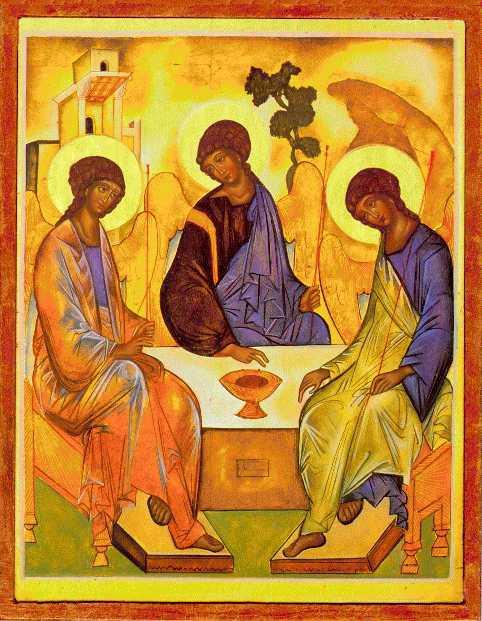
    In a guidebook to Fountains Abbey in Yorkshire, England, under an illustration of the monk's chapel reads the following description: "Here the monks gathered every Sunday to hear a sermon from the Abbot, except on Trinity Sunday, owing to the difficulty of the subject."

    How does one describe the indescribable? Or express the inexpressible?

    After all, in portraying the Trinity you and I are painting a vast rainbow with only charcoal pencils. As Archbishop Rowan Williams puts it, "even in banal contexts we are aware of the fact that our pigeonholes for things, people, emotions and perceptions, are often lagging well behind the fluidity of the real world... and whether it is in theoretical physics or in poetry, we need to express some sense of this strange fact that our language doesn't 'keep up' with the multiplicity and interrelatedness and elusiveness of truth."

    And of all the elusive truths you and I can talk about, God pretty much tops the list.

    Since the beginning of time humans, most of whom seem to have a natural and innate suspicion of 'God,' have struggled to figure out if there, indeed, is one. The illustration above is that of a Roman altar dedicated 'to the unknown God,' which, if taken quite literally, encompasses just about everyone's idea of God, Christianity's included.

    Trinity Sunday poses several questions. Can we ever really 'know' God? Can we come to a convincing certainty, like that of the keyboard underneath my fingers or the car parked in my garage - can I know God with the same confidence? If we say 'no' does that mean there is no God? If we say 'yes' then does that mean we have finally ascended to the pinnacle of religious faith?

    For Trinity Sunday asks you and me to come to grips with the fact that we will not, cannot and will never know everything - actually, much of anything - about the universe in which we live and about the God whom we worship.

    However, as Christians, we do believe we have enough to go on to get us this far. After all, I know very little about what takes place underneath the hood of my car, but I trust it with my life every time I drive to work. We know that the life and ministry of Jesus has touched us and changed our lives. It has introduced us to the deepest love human life has to offer.

    So Trinity Sunday, if nothing else, helps you and me make peace with the great unknown, for we trust it to God's omniscient power. Which means the exercise in faith you and I participate in on this day is one in which we assure ourselves of the basic truths of our faith: God takes care of the birds, God waters the flowers, how much more will God take care of you and me? Trinity Sunday asks us to be content amidst the unknowableness of God, let God be God, and let us be who we are; fully able to embrace love, which is God.

    Website:
    www.gratefulness.org
    www.kiva.org
    www.nothingbutnets.net
  • Pentecost 2009


    A ruckus of babbling Jews on festival day in Jerusalem 2,000 years ago-
    Was it a caucus in the United Nations Building?
    Or at least Last Call at the bar in the basement of said building?
    After all ‘They’re drunk, they’re drunk!’ was the very first accusation.
    How else could the people we know and love, from the lakes and swamps of Michigan spout off the praises of God in the languages of Nigeria, Liberia, France, Ukraine, Germany, Armenia, Jamaica, Greece, Spain and even the British Empire-

    It’s a sign!
    It’s a wonder!
    It’s a miracle!

    That was the final conclusion, and conclusive proof that God would never be content in far away places. But God, a novena after ascending into heaven, had to come down to be close to the ones God so loves; to do the work of repairing the world that God so desperately wants done.

    Pentecost tells us that God has come to town.
    Love has come to town.
    Love that wants to get closer to you-
    And Love that you and I want to get closer to as well.

    Love that doesn’t just fill heaven and earth, or upper rooms at religious festivals, but love that fills you and me as well. For the infilling of the Holy Spirit does more than simply make us warm and fuzzy. The knowledge of God’s presence with us makes Christians confident, dynamic, assertive and charismatic, even Episcopalians, no less, aka the bland leading the bland.

    Thanks to the Holy Spirit you and I receive the Spirit’s presence in a number of different ways. We receive just the right words of wisdom to offer to the distressed that we never thought we had. We gain strength to go through adverse times, and patience through the most trying of challenges. The Holy Spirit is that presence of God that dwells with us and gives us things we commonly call intuition, inner fortitude, and especially inspiration.

    And, perhaps most importantly, the Holy Spirit constantly reminds us that we do not go through life alone. Rather, we go with God, who has promised to never leave us. How is the Holy Spirit manifest in your life? How might we make more room for the Spirit to move in and through us today and in the week ahead?
  • Weighing Anchor


    My church is in the midst of a three week sermon series called 'Anchor.'
    We are looking at ways we Christians respond to difficult financial struggles.
    We remind ourselves that that anchoring our lives in Christ frees us from many of the financial worries that are plaguing the world - not because we don't have these worries, but because we believe in Jesus who asks us to hand them over to him. We do this by taking a hard look at what our money means to us, and breaking it down, as Mark Allan Powell does in his excellent book 'Giving to God,' into three areas. We remind ourselves that we use our possessions as; an act of worship, an expression of our faith, and as a spiritual discipline.

    Last week we recounted primitive Old Testament worship, vestiges of which we still hold to today, that depicted the acts of the faithful who brought to the Lord from the 'first fruits' of their labors. The devoted then, as now, had a solid grasp on God's love and faithfulness toward them that had allowed them to prosper, to a degree, and accumulate crops, livestock, and other things. Thus, as an act of pure worship, these thankful souls literally brought crops and animals and other products unto the altar on a regular basis for no other reason than to simply say 'thanks.' They realized, as we do today, that 'all things come of thee O Lord, and of thine own have we given thee.'

    This week we look at how we free ourselves from financial worry when we use our possessions as expressions of our faith. One of the earliest words we learn as children is 'mine.' We use it with our toys our clothes, everything. And like most every other aspect of childhood, growing up means we leave this kind of thinking behind. It takes us many years to figure out that nothing, in fact, is 'mine.' We are all stewards of what has been given to us. Like someone once remarked to me in the restroom of a bar as he described the essential nature of beer: we just rent it.
    Understanding ourselves, then, not as owners, but as renters, gives way to new understandings of how we approach possessions and charity, freeing us up to let the Landlord do the bulk of the worrying.

    Next week we will look at our possessions as tools to bring us into deeper relationship with Christ. I believe money can bring us happiness -when we give it away -by helping us anchor our lives even more securely in the heart of Jesus. Charitable giving is one of Christianity's longest-standing Spiritual Disciplines. Behavioral psychologists have shown that people who successfully delay gratification as children grow up to be more successful in life than those who are less disciplined. We know that our discipline in eating or in physical exercise can yield terrific results, helping us become the kind of people we want to be. How much more, then, do exercises in almsgiving and charity make us more of the devoted followers of Christ we long to be?

    'Cast all your cares upon me,' says our Lord, 'and I will take them.'
    How we yearn to do and believe this! May our interest in using this
    economic crisis as an opportunity to grow closer to Jesus yield great
    dividends.


    Recommended Reading:
    Giving to God - Mark Allan Powell
    A Simpler Way - Margaret Wheatly
    Transforming Scripture - Frank Wade
  • Thanks Mom!


    “Washington’s Birthday is for the ‘Father of our Country’; Memorial Day honors our ‘Heroic Fathers;’ Fourth of July is for our ‘Patriot Fathers;’ Labor Day is for Laboring Fathers; Thanksgiving Day remembers our ‘Pilgrim Fathers’; and even New Year’s Day looks to Old Father Time.” Where, on our patriarchal calendar, wondered devout Protestant Anna Jarvis, is there room for dear old Mom?

    Her tireless labors are well-documented, and birthed for us, less than 100 years ago the holiday we celebrate this Sunday – Mother’s Day.

    Founded in a church, nurtured in the marketplace, and now, continuing to morph in our post-modern and post-Christian society; Mother’s Day is open to all sorts of interpretations.

    Its most enduring, however, is the thanks each one of us has for the lives we have been given and our mutual conviction that we did not get here all by ourselves. Sure, some of our mothers did better jobs than others. Most probably they did the best they could, whether they gave us blissful childhoods or fell well short of what we might think is minimally acceptable motherhood. And this momentary tip of the hat we now give is emblematic of a larger issue.

    For just as there is a unique, life-giving bond between every mother and child, there is a unique, life-giving bond between every human and God.
    Our mother’s role serves to remind us not only of our sheer and utter dependence on that one-time, and for many of us, continuing bond, but of all the responsibilities that arise from that relationship-
    -and, in the context of our faith, to re-examine the bonds that exist between each one of us and our creator.

    So just as we honor our mothers, we ask ourselves how we are called to honor our God. What maternal responsibilities do we have?
    What divine responsibilities do we have?
    Let’s remember Mom with all the honor that’s due.
    Let’s remember God with all the honor that’s due.

    -----------------
    For a great history of Mother’s Day:
    Consumer Rites- Leigh Eric Schmidt
  • Swine Flu and Shared Cup


    If concern about Swine Flu has you stocking up on hand sanitizers and questioning why any 21st century congregation would commend a common cup at Communion, you’re not alone. Recently Catholics and Methodists in southern Texas called for a halt to use of a shared chalice until more is known about the deadly virus.

    However using a shared cup for Communion wine, as most Episcopal congregations do, is not as hazardous as one might expect. Episcopalians use a rather strong wine, often port, which has a much higher alcohol content than table wine. In 2000 a Canadian cardiologist named David Gould studied the issue and concluded that this high alcohol content means, “For the average communicant it would seem that the risk from drinking from the common cup is probably less than the risk of air-borne infection from using a common building.”

    That said, the unknowns associated with this outbreak certainly merit reasonable cautions, and whatever your congregation’s response, it is important to keep in mind the Eucharistic theology shared by most Episcopalians. We believe in the real presence of Christ in the bread and in the wine. This means embracing the new math of God’s Grace; if you consume just the consecrated bread (often the practice of alcoholics) or just the consecrated wine (as do many with gluten allergies) you are still getting all of Jesus.

    Can this be an opportunity to ponder anew what the Eucharist really means to us?
  • The Jitters


    It’s one of the distinctive traits of many animals, specifically sheep, whose top-heavy coats and lack of any real defensive qualities (strong jaws, sharp claws, speed…) seem to make everyday life one big worry, observable by even the most casual observer. And truth be told, sheep aren’t the only animals whose trepidation and anxiety over food, shelter and safety tend to dominate their countenance. “We, like sheep…” goes the Handel oratorio, reminding us, as Isaiah, its inspiration more fully describes, that the jitters are an integral part of the human condition.

    When we break down the things that trouble us most we may find, as the main character in Andy Andrews ‘The Noticer” puts it; “Forty percent of the things you worry about will never occur… Thirty percent of the things you worry about are things that have already happened… Twelve percent of all worries have to do with needless imaginings about health… Ten percent would be petty little nothing worries about what other people think… So if the math is right that leaves eight percent… eight percent for legitimate concerns… these legitimate concerns that can actually be dealt with. Most people spend so much time fearing the things that are never going to happen or can’t be controlled that they have no energy to deal with the few things they can actually handle.”

    The constant presence of the jitters may be one reason why the first and most popular characterization of Jesus was that of a shepherd, as the earliest catacomb art suggests (see above, 250CE, Rome). And while Jesus’ image has gone through a gauntlet of interpretations through two millennia (The Rabbi- 1st Century, King of Kings-4th Century, The Liberator-20th Century, etc. [see Jaroslav Pelikan ‘Jesus Through the Centuries]), the pervasive representation of Christ as one who tends, cares, and knows us as a shepherd knows his flock, continues to comfort, bring relief and inspire the sheep.

    This image of the shepherd (John 10:11-18, this Sunday's Gospel reading) suggests that Jesus is fully invested in us. He does not care for us casually or lightly, but deeply and intimately. His love for us is not something based on personal gain - which is why it is so hard for us to understand. God loves us because God IS love. God does not expect to get anything out of us - rather he seems to exist to do nothing other than to love us.

    The question for us is, and always will be, how do we respond?
    In fact, the most important question that hits us as each morning as we get up out of bed is this: how will I respond to God’s love today?

    How will you?
  • Build Your Own Church


    Tired of the crowded church parking lot?
    Build your own.
    Read how this couple did it.
    (Thanks to Maggi for the link)
  • Can We Believe It?


    First they hear it from their friends.
    Next they hear it from The Source.
    Finally they hear it from their most sacred text.
    And they still don’t believe it.

    “Jesus has risen!” say their best buds (from next Sunday’s Gospel Luke 34:26-48).
    “Look at my hands, my feet, see that it is myself,” says the Christ.
    Examine the Scriptures, is the final instruction.
    And finally they do get it.
    But only after Jesus spent a whole lot of time and effort trying to convince his closest friends that he was who he said he was.

    Then, as is now, Jesus continues to spend a whole lot of time and effort trying to convince his closest friends that he is who he says he is.

    We just don’t seem to be able to wrap our heads around the truths that Jesus continues to communicate to us regarding who we are and who he is.
    Sure, we buy into the elemental convictions that define Christians, but what about the more difficult truths?

    Do we have any idea how much God loves us?
    Psalm 18 says, the Lord “…delights in me.”
    Do we have any idea how forgiven we are?
    Luke 24 says declaring repentance and forgiveness was the disciples’ first job.
    Do we have any idea how everything that has, is, and will ever happen to us is not only known but served amidst the clamoring of the house band’s ever-new rendition of ‘All Right Now’? Here's a cool rendition from the archives...


    This last one seems to be the most challenging.
    We are constantly worried.
    Anxiety levels have never been higher.
    Since stress is the number one cause of cancer, this is literally killing us.

    So, while keeping in mind that faith is not just a noun, but a verb, here are a few tips that may help us believe more fully in the promises of the resurrected Christ:

    Cultivating a Spirit of Hope in Tough Economic Times

    1. Clear out the media clutter. Turn off the TV. Don’t read every newspaper. Cut off the radio. We are inundated with far more influences than we need pay attention to. Get in the habit of filtering and editing the media clutter. Why not give silence a try on the ride home?
    2. Connect with God. Are we reading inspirational books? Are we cultivating our prayer time? When was the last time we went on a retreat? We were created to connect with God. We are sure God is talking, but how well are we listening?
    3. Tend to our bodies. Exercise regularly, get plenty of sleep and eat right. It’s hard to be hopeful when we’re tired, ill or just plain out of shape. These are some of the most important things we can do to keep our spirits up. We always feel proud of ourselves when we’ve taken care of our bodies, and are often rewarded with more energy and sharper focus.
    4. Go to church. The Good Book reminds us that good company inspires good morals. If we want to do the next right thing, let’s hang around people who share the same goals. Going to church connects us with a caring community of people who love us for who we are not what we do. We need to be constantly reminded that there is purpose to our lives and that nothing happens by accident.

    Check out these blogs:
    www.michaelhyatt.com
    www.brianmcclaren.com
    www.shanehipps.com
  • Got Faith?


    Eastertide, and especially this Sunday’s gospel about Jesus’ encounter with the infamous ‘doubting’ Thomas (wouldn’t a better adjective be ‘believing’ Thomas?), brings up very personal questions regarding our understandings of faith.

    John Westerhoff III describes our faith journeys in a way I’ve found helpful. Using four stages, through which we constantly move in and out as we grow older, see if you can see where you’ve been, where you are, and where you’d like to go:

    1. Experienced faith – this is the faith of a child imitating prayers, like the ‘Our Father.’ There is very little or no understanding of what’s going on.
    2. Affilliative faith – this is the faith of an older child or teen who, plays along with the crowd because, ‘that’s just what we do,’ like youth group affiliation, even church membership. It is still centered on imitation although there may be a little understanding of what’s happening.
    3. Searching faith – this usually hits in late adolescence or early adulthood when the question is sincerely asked, ‘What do I believe?’
    4. Owned faith – early or late adulthood, if at all. This is where Thomas ended up when he declared, ‘my Lord and my God.’ It is an adult articulation of one’s beliefs about human existence in relation to God and Creation.

    If you see a little bit of yourself in each stage, relax, that’s normal. We all divide our faith between the four. However we are wise to recognize the progressive nature of these stages. We are to move toward an ‘owned faith’ where our journeys become more and more centered on plumbing the depths of what calling Jesus ‘Lord’ is really all about.

    Eastertide asks us to ponder the breadth of Thomas’ confession and its ramifications. How much of our faith do we ‘own?’ Are we content simply affiliating, going along for the ride and avoiding the difficult questions of commitment, personal sacrifice and ownership? How does calling Jesus ‘Lord’ affect various aspects of our lives, for example; our personal finances, neighborhood and community involvement, job (vocation) and family relationships?

    Resources
    ‘Will Our Children Have Faith? – John Westerhoff III
    ‘Stages of Faith’ – James Fowler
  • In the Dark We See the Light


    Candles don’t work real well during the day.
    Matches used to light candles don’t get used too much during the day.
    Lighting a candle in broad daylight is rather a waste.
    It always helps to turn off a light… or two… or three… or more
    Light can only do its job if it’s got a little bit of darkness to play around with-
    -if it can swim steadily in a pond of no other illumination.

    Holy Week, Palm Sunday (this Sunday)…
    … are times of darkness.
    Intentional darkness…
    …when you and I deliberately face the darkness so that we can see the light.

    We never have to go far to find the darkness.
    It comes from every direction-
    -and we avoid its stare as a matter of course.
    Which is why the Church has Holy Week.
    We face the darkness so that we might see the light.
    We deal best with the darkness, not by avoiding it, or pretending it’s not there but by facing it squarely.

    It is the darkness of our own hypocrisy.
    ‘Hosanna, hosanna, hosanna to the Son of David’ we cry, moments before this:
    ‘What do you wish me to do with the man you call the King of the Jews?" Pilate asked.
    "Crucify him!" we shout back.

    I am constantly amazed at my own ability to change allegiances at the drop of a hat.
    I am astounded at my own sinful proclivity to say one thing and do exactly the opposite.
    I am amazed at my own ability to promote and inhabit the darkness.

    Yet Holy Week is not ultimately about darkness-
    -it is about the proverbial light at the end of the tunnel.
    Holy Week ends in unimaginable light.
    Holy Week ends in a hope and happiness that is better than we could ever dream.

    Holy Week is about finding the light-
    Rediscovering it anew, turning to it and turning everything over to it.
    What can I do to get there?
    Why not walk through Holy Week at your local church?
    There are few better avenues to draw nigh unto God.
  • Total Pageviews

    Search This Blog

    Blog Archive

    Powered by Blogger.
    ADDRESS

    St. David's Episcopal Church, 16200 W. Twelve Mile Road, Southfield, MI 48076 USA

    EMAIL

    chris@stdavidssf.org

    TELEPHONE

    +011 248-557-5430