Chris Yaw

I am a Christ Lover

Chris Yaw

Welcome! I’m an Episcopal priest serving a congregation in Metro Detroit... With a passion for gun safety... A zest for online Christian formation... A zeal for video blogging... A budding writer... A heart for those who have unintentionally harmed... A commitment to workforce housing... A love for marrying people... And a wonderful wife, three kids, and a cat... If we have common interests or not, I'd love to connect with you.

Me

Contact Details


  • St. David's Episcopal Church, 16200 W. Twelve Mile Road, Southfield, Michigan, 48076, USA


  • +011 248-557-5430


  • chris@stdavidssf.org

St. David's

I have served as rector of St. David's Episcopal Church in Southfield, MI for 16 years, join us Sundays in person or via zoom.

Disarmory Ministries

Working on the issue of unwanted gun disposal, we've made some real progress in helping rid the U.S. of unwanted firearms.

ChurchNext

Since 2013 we have been helping people learn more about faith through our online learning courses at ChurchNext.

Oakland Housing

Helping middle income families get better housing is a challenge that Oakland Housing has been addressing for 75 years.

Hyacinth Fellowship

Because hurting others hurts us, the Hyacinth Fellowship organizes support groups and reminds us that we are not our worst mistakes.

Yaw Wedding

I have been officiating for more than 20 years and continue to find joy in helping couples build lifelong relationships.

0
U.S. Guns Produced Today
0
Americans Accidentally Killed Today
0
Homeless Americans
0
Weddings Performed
  • The Jitters


    It’s one of the distinctive traits of many animals, specifically sheep, whose top-heavy coats and lack of any real defensive qualities (strong jaws, sharp claws, speed…) seem to make everyday life one big worry, observable by even the most casual observer. And truth be told, sheep aren’t the only animals whose trepidation and anxiety over food, shelter and safety tend to dominate their countenance. “We, like sheep…” goes the Handel oratorio, reminding us, as Isaiah, its inspiration more fully describes, that the jitters are an integral part of the human condition.

    When we break down the things that trouble us most we may find, as the main character in Andy Andrews ‘The Noticer” puts it; “Forty percent of the things you worry about will never occur… Thirty percent of the things you worry about are things that have already happened… Twelve percent of all worries have to do with needless imaginings about health… Ten percent would be petty little nothing worries about what other people think… So if the math is right that leaves eight percent… eight percent for legitimate concerns… these legitimate concerns that can actually be dealt with. Most people spend so much time fearing the things that are never going to happen or can’t be controlled that they have no energy to deal with the few things they can actually handle.”

    The constant presence of the jitters may be one reason why the first and most popular characterization of Jesus was that of a shepherd, as the earliest catacomb art suggests (see above, 250CE, Rome). And while Jesus’ image has gone through a gauntlet of interpretations through two millennia (The Rabbi- 1st Century, King of Kings-4th Century, The Liberator-20th Century, etc. [see Jaroslav Pelikan ‘Jesus Through the Centuries]), the pervasive representation of Christ as one who tends, cares, and knows us as a shepherd knows his flock, continues to comfort, bring relief and inspire the sheep.

    This image of the shepherd (John 10:11-18, this Sunday's Gospel reading) suggests that Jesus is fully invested in us. He does not care for us casually or lightly, but deeply and intimately. His love for us is not something based on personal gain - which is why it is so hard for us to understand. God loves us because God IS love. God does not expect to get anything out of us - rather he seems to exist to do nothing other than to love us.

    The question for us is, and always will be, how do we respond?
    In fact, the most important question that hits us as each morning as we get up out of bed is this: how will I respond to God’s love today?

    How will you?
  • Build Your Own Church


    Tired of the crowded church parking lot?
    Build your own.
    Read how this couple did it.
    (Thanks to Maggi for the link)
  • Can We Believe It?


    First they hear it from their friends.
    Next they hear it from The Source.
    Finally they hear it from their most sacred text.
    And they still don’t believe it.

    “Jesus has risen!” say their best buds (from next Sunday’s Gospel Luke 34:26-48).
    “Look at my hands, my feet, see that it is myself,” says the Christ.
    Examine the Scriptures, is the final instruction.
    And finally they do get it.
    But only after Jesus spent a whole lot of time and effort trying to convince his closest friends that he was who he said he was.

    Then, as is now, Jesus continues to spend a whole lot of time and effort trying to convince his closest friends that he is who he says he is.

    We just don’t seem to be able to wrap our heads around the truths that Jesus continues to communicate to us regarding who we are and who he is.
    Sure, we buy into the elemental convictions that define Christians, but what about the more difficult truths?

    Do we have any idea how much God loves us?
    Psalm 18 says, the Lord “…delights in me.”
    Do we have any idea how forgiven we are?
    Luke 24 says declaring repentance and forgiveness was the disciples’ first job.
    Do we have any idea how everything that has, is, and will ever happen to us is not only known but served amidst the clamoring of the house band’s ever-new rendition of ‘All Right Now’? Here's a cool rendition from the archives...


    This last one seems to be the most challenging.
    We are constantly worried.
    Anxiety levels have never been higher.
    Since stress is the number one cause of cancer, this is literally killing us.

    So, while keeping in mind that faith is not just a noun, but a verb, here are a few tips that may help us believe more fully in the promises of the resurrected Christ:

    Cultivating a Spirit of Hope in Tough Economic Times

    1. Clear out the media clutter. Turn off the TV. Don’t read every newspaper. Cut off the radio. We are inundated with far more influences than we need pay attention to. Get in the habit of filtering and editing the media clutter. Why not give silence a try on the ride home?
    2. Connect with God. Are we reading inspirational books? Are we cultivating our prayer time? When was the last time we went on a retreat? We were created to connect with God. We are sure God is talking, but how well are we listening?
    3. Tend to our bodies. Exercise regularly, get plenty of sleep and eat right. It’s hard to be hopeful when we’re tired, ill or just plain out of shape. These are some of the most important things we can do to keep our spirits up. We always feel proud of ourselves when we’ve taken care of our bodies, and are often rewarded with more energy and sharper focus.
    4. Go to church. The Good Book reminds us that good company inspires good morals. If we want to do the next right thing, let’s hang around people who share the same goals. Going to church connects us with a caring community of people who love us for who we are not what we do. We need to be constantly reminded that there is purpose to our lives and that nothing happens by accident.

    Check out these blogs:
    www.michaelhyatt.com
    www.brianmcclaren.com
    www.shanehipps.com
  • Got Faith?


    Eastertide, and especially this Sunday’s gospel about Jesus’ encounter with the infamous ‘doubting’ Thomas (wouldn’t a better adjective be ‘believing’ Thomas?), brings up very personal questions regarding our understandings of faith.

    John Westerhoff III describes our faith journeys in a way I’ve found helpful. Using four stages, through which we constantly move in and out as we grow older, see if you can see where you’ve been, where you are, and where you’d like to go:

    1. Experienced faith – this is the faith of a child imitating prayers, like the ‘Our Father.’ There is very little or no understanding of what’s going on.
    2. Affilliative faith – this is the faith of an older child or teen who, plays along with the crowd because, ‘that’s just what we do,’ like youth group affiliation, even church membership. It is still centered on imitation although there may be a little understanding of what’s happening.
    3. Searching faith – this usually hits in late adolescence or early adulthood when the question is sincerely asked, ‘What do I believe?’
    4. Owned faith – early or late adulthood, if at all. This is where Thomas ended up when he declared, ‘my Lord and my God.’ It is an adult articulation of one’s beliefs about human existence in relation to God and Creation.

    If you see a little bit of yourself in each stage, relax, that’s normal. We all divide our faith between the four. However we are wise to recognize the progressive nature of these stages. We are to move toward an ‘owned faith’ where our journeys become more and more centered on plumbing the depths of what calling Jesus ‘Lord’ is really all about.

    Eastertide asks us to ponder the breadth of Thomas’ confession and its ramifications. How much of our faith do we ‘own?’ Are we content simply affiliating, going along for the ride and avoiding the difficult questions of commitment, personal sacrifice and ownership? How does calling Jesus ‘Lord’ affect various aspects of our lives, for example; our personal finances, neighborhood and community involvement, job (vocation) and family relationships?

    Resources
    ‘Will Our Children Have Faith? – John Westerhoff III
    ‘Stages of Faith’ – James Fowler
  • In the Dark We See the Light


    Candles don’t work real well during the day.
    Matches used to light candles don’t get used too much during the day.
    Lighting a candle in broad daylight is rather a waste.
    It always helps to turn off a light… or two… or three… or more
    Light can only do its job if it’s got a little bit of darkness to play around with-
    -if it can swim steadily in a pond of no other illumination.

    Holy Week, Palm Sunday (this Sunday)…
    … are times of darkness.
    Intentional darkness…
    …when you and I deliberately face the darkness so that we can see the light.

    We never have to go far to find the darkness.
    It comes from every direction-
    -and we avoid its stare as a matter of course.
    Which is why the Church has Holy Week.
    We face the darkness so that we might see the light.
    We deal best with the darkness, not by avoiding it, or pretending it’s not there but by facing it squarely.

    It is the darkness of our own hypocrisy.
    ‘Hosanna, hosanna, hosanna to the Son of David’ we cry, moments before this:
    ‘What do you wish me to do with the man you call the King of the Jews?" Pilate asked.
    "Crucify him!" we shout back.

    I am constantly amazed at my own ability to change allegiances at the drop of a hat.
    I am astounded at my own sinful proclivity to say one thing and do exactly the opposite.
    I am amazed at my own ability to promote and inhabit the darkness.

    Yet Holy Week is not ultimately about darkness-
    -it is about the proverbial light at the end of the tunnel.
    Holy Week ends in unimaginable light.
    Holy Week ends in a hope and happiness that is better than we could ever dream.

    Holy Week is about finding the light-
    Rediscovering it anew, turning to it and turning everything over to it.
    What can I do to get there?
    Why not walk through Holy Week at your local church?
    There are few better avenues to draw nigh unto God.
  • Come to the Light


    A race.
    30 years ago.
    Everyone’s forgotten.
    I never will.

    Lacing up soft leather cross-country cleats, I eyed the damp fall course, oak leaves angling to conceal the three mile ribbon of chalk dust that would decide who goes to the State meet and who stays home.

    A gifted runner, why break a sweat, I thought, as I fantasized how the bright red stripe on my letter sweater would look, in the same way a bride imagines that moment when the music goes to Mendelssohn and a church full of elegant necks strain and crane to catch a glimpse of her.

    Off went the gun.
    A puff of smoke, the pound of the herd, the rainbow streak of 1980’s mesh jerseys from every high school in the county, vying for the top 15 spots, All-Region status, and another wood and gold trophy destined to find homes fronting bedroom bookcases, like household idols.
    Rarely is such value ascribed to such cheap plastic.

    I took the lead.
    Then slipped back.
    Why bother, I thought, when Top-15 was my only goal that day.
    My laxity increased.
    It would become my second biggest problem.
    My biggest would be arithmetic.
    I had counted 14th when I crossed the finish line.
    The judges had counted differently.
    This I learned as I eyed the numbered, wooden place card now clutched and about to snap in my anxious and sweaty hand.
    It read 16th.

    Few things are this infuriating.
    A goal, well in view, yet slips away.
    Had I given more, had I focused more, had I allowed myself to give any less than my all, I would not be here.
    A lesson from a race.
    A lesson for life:
    Can I ever really be content when I give anything less than my all?

    “Come to the light, so that it may be clearly seen that their deeds have been done in God,” reads John 3:21.
    It is an invitation not to come part way or halfway, but to come, with all that we are, all the energy we can muster, avoiding the darkness, coming to the light.

    Nicodemus is you and me.
    He recognizes Jesus with clarity and caution.
    He comes at night, away from the crowds and conclusions that a midday visit would surely draw.
    Nicodemus, you and me… followers of Jesus whose reputations are in jeopardy every time we draw closer to the light.

    Why follow more closely, we wonder.
    Can’t I stay a safe distance, can’t I put some of my energies elsewhere?
    Must I really die?
    I have goals: to find purpose, to find meaning, and to give back.
    I have found that goal in Jesus.
    I know who I am, I know who I can be, and I know how to love, in Jesus.
    I know I am my best self, in Christ.
    But can’t I get there by giving a bit less than my all?
    Can I hold back anything?
    Must I surrender everything?

    Can I really be my happiest by giving less than 100%?

    That’s an easy one.
    Just ask any runner who’s every finished 16th.


    Recommended Books:
    The Last Week –Marcus Borg & Dominic Crossan
    Reading the Bible Again for the First Time – Marcus Borg
    The Promise of Paradox – Parker Palmer
  • 'Wejus' Praying


    Ever prayed with a person or a group of people whose most commonly used petitionary word is 'wejus' - as in 'Lord wejus want to come before you... wejus want to thank you... wejus... wejus... wejus...?'

    When I was a younger Christian I prayed like this, but over the years it has become somewhat annoying. I mean, I don't talk to anyone else like this, much less someone I am interested in impressing. What if I were called to lead a group of pastors to the Oval Office to petition for, say, better health care for the poor, a decrease in military spending or a more equitable tax scheme, would the president take me very seriously if my petitions were as heavily peppered with, 'wejus....'?

    The fundamental problem I have with 'wejus' praying is its flawed soteriology - what it says about the saving work of Christ. A major theme of 1979 Book of Common Prayer worship, expressed plainly in Eucharistic Rite II, Prayer B tells us we are, 'worthy to stand before you' - suggesting our relationship with God is as one who joyfully receives a gracious gift given in spite of our shortcomings. No, we do not deserve to belong to Christ, we have sinned grievously and repetitively. However, we are saved, forgiven, and able to, 'approach the throne boldly' (Hebrews 4:16) if we believe what we say we believe. Thus, we really ought to act like this, especially in public petition. 'Wejus' praying seems to suggest a profoundly unbiblical understanding of this salvation. While I admire, and perhaps need to model, the humility attempted in this style of petition, I wonder if it is misplaced and needs to be thought through by the petitioner.

    What's more, 'wejus' praying sounds disingenuous, as if our petitions are to be answered because we have taken on some sort of faux-humble vocabulary, when we know that our petitions are not met because of what we've done, or even who we are, but because of who God is.

    So if you are a 'wejus' person, I am not trying to make you angry - and I apologize if I have offended you - however I am asking you to think through how you approach the Almighty in public prayer. When God gave us this amazing gift of Jesus it was not to turn us into endless penitents, but victorious saints whose words of public petition ought to create an atmosphere of gracious invitation and boundless possibility, which seems to be much more in keeping with the personality of the God of the Bible. It makes me think that more people who pray in public might want to think this through.
  • The Life We Really Want


    What makes us think that following Jesus simply requires a minor adjustment to our ordinary lives?

    In a world that equates claiming Jesus alongside our preference for choosing one style of sneaker over another, one brand of peanut butter compared to a second, and the blue packet, not the pink one, thank you, as sweeteners in our coffee, this passage stands out like a muumuu in a nudist colony.

    GK Chesterton famously said Christianity has not been tried and found wanting, but rather, found difficult and not tried. These harsh words of discipleship become the first ones Jesus says to his friends following the revelation that he is the Christ and that he is headed to Jerusalem. These are the first things Jesus tells you and me when we decide, at our baptism, confirmation, re-affirmation or whenever we decided to get serious about Jesus, that the road ahead is not distinguished by luxury and leisure (which is why bishops used to slap confirmands on the cheek following their commitments).

    This, of course is not the Jesus talk that makes friends and influences people. It is revolutionary talk that gets him killed. It is talk that misguided church folk sanitize, disinfect and sweep out of our churches as best we can, for were we to take them seriously we would not only risk being treated as pariahs by friends and relatives, but we would pass up those temporary and fleeting possessions, experiences and self images that we have somehow convinced ourselves are so important to living the Good Life.

    There is simply no way to get around the harshness of these words.

    And there is no way getting around the truth of these words.

    For Jesus didn’t give them to us to afflict us or to torture us but to tell us that this is what the world is really like.

    When we tell our children not to lie it’s not so much because we want them to live up to some ethical standard, or to keep them from embarrassing us in front of the neighbors, but we teach them not to lie because they can’t. To live a life based on lies is not life at all. Sooner or later you’re caught, and any short-term gain you’ve made is quickly erased and there is more pain and hardship to bear than if the road of truth had been taken.

    M. Scott Peck famously started off one of his books with the words, ‘Life is difficult.’ And he did so in the same way Jesus does here – he simply wants to tell us the truth. It’s not that there is no luxury or ease, it’s just nobody’s life is like that all the time. Why is suicide the 11th ranked killer in the affluent United States and nearly undetectable in impoverished Haiti? Life is difficult by definition. That’s the way the world is made, and if we really want to live the best life there is, it is through the Jesus way. Many of us will attest to the fact that any other route takes us through even bumpier roads and even deeper heartaches.

    So as difficult as these words appear, they are like filthy oysters that hide the pearl of great price. For inside we find the life we’re looking for, and life more abundantly.
  • Sweet Temptation


    Ever since Adam and Eve said yes to the apple, temptation has gotten a bad rap.

    After all, the word simply means ‘tested,’ or ‘tried,’ which is innocent enough. The fact is that temptation presupposes some rather important realities. First, the idea of temptation means we have the liberty to choose one option versus another. We often overlook the blessing of freedom to do as we choose, which also bespeaks a depth of love of the Creator who made things that way. Second, temptation is a commentary on desire. Our temptations assure us that much about this world is desirable, that God made a world in which there are many things we might call, ‘good.’ And finally, with reference to Sunday’s Gospel reading which tells us that following Jesus’ baptism, “the Spirit immediately drove him out into the wilderness (where he was) tempted by Satan…” we cannot help but link temptation to the work of the Holy Spirit.

    What? God-ordained temptation?!?

    As puzzling as this may sound, especially in light of Jesus’ own teaching on prayer which asks us to petition the Lord to, “…lead us not into temptation…” we need to take this at face value and ponder what good there might be in the tests you and I face throughout our lives.

    This is not to validate the blathery condolences we often hear from well-meaning, though dim-witted friends, who suggest that every tragedy and disaster is the machination of a puppeteer God who delights in human suffering – we all need to speed up to avoid that exit ramp on the theological highway. However, it is to say that God seems to use the testing of our faith to help us be who we really want to be. In other words, temptation may be an expression of God’s desire to love us.

    I have heard sin defined as our own insistence on being what we are not – a desire for a life other than the one we are given. When we think about this, and ruminate over our own dissatisfactions over who we are, we can begin to see our own behaviors and beliefs produce many of the temptations we face. Why be tempted to spend more on home, car or clothes if we are really secure in our own self-images and not overly concerned with the opinions of others? Why be tempted to put down others when we are contented in who we are - and do not need to build ourselves up by pushing others down?

    Temptation, a way to spiritual maturity? Think about it.
  • Facing the Truth


    Once you know the truth you can stomach all sorts of lies.

    It’s what gives us patience with the sticky-fingered four year old who swears up and down he hasn’t taken a sweet before dinner.
    It’s what helps us write off the 10-spot we just gave the homeless person who promises he will pay us back next week.
    And it’s why we root for the Lions but bet on the Bears.

    Once you know the truth you can stomach all sorts of lies.

    The inherent problem, of course, is recognizing the truth-
    We are such doubters-
    -and our biggest accuser stares out at us, with groggy eyes, every morning in the mirror.
    “Does he still love me?” asks the worried wife of 30 years when her husband goes through one of his typical phases of spousal inattention.

    “Could it be the big C?” we ask ourselves as we probe the small, sub dermal lump beneath the dripping shower head. Most lumps are benign, and this one probably is too, but we veil the truths of probability and statistics behind illogical clouds of festering doubt that keep us from keeping our heads.

    We need truth.
    We need to be reminded.
    We need to jog our memories.
    We need to beat ourselves over our heads with it.

    For once you know the truth you can stomach all sorts of lies.

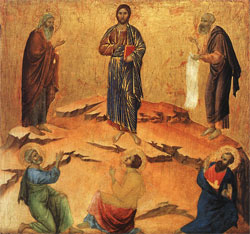
    The big hullabaloo on Mt. Hermon, as it is known today in modern Syria-
    -was just that sort of event.
    The Transfiguration (this Sunday’s gospel reading) was stark truth.
    It was awesome. It was astounding. It was unveiled, unadulterated, and absolutely terrifying.
    It was staged for those closest to Jesus and meant to show them the truth.
    Because in the days ahead they would be beating back all sorts of lies.

    How do we understand this truth?
    How might we begin to shun the lies?
    How can we walk more intentionally in truth?
  • Spiritual Obesity


    Early Christians were often labeled by their critics as incestuous, because they called one another 'brother and sister,' atheistic, because they worshiped a god who was invisible, and cannibalistic, because they insisted they were eating the body and blood of a dead person.

    This last criticism is rooted in St. John's quoting Jesus and a lengthy discourse on the subject which asserts, "Those who eat my flesh and drink my blood abide in me, and I in them." (6:56) Without touching on the centuries old debate regarding the literal meanings suggested here, we do well to consider the subject metaphorically. For what we consume, consumes us.

    Like the four food groups, we might sort the Christian endeavor into four basic groups: prayer, work, study and entertainment. And, using the diagram above, we do well to order our portions accordingly; prayer being the foundation upon which the Christian life thrives, work being the carrying out of our vocation inside and outside the home, study being that which informs and moves us further toward maturity, and entertainment, that which feeds the imagination and fulfills the artist in us all.

    As we all know the age-old presence of evil continually seeks to turn this pyramid upside down, and successfully so in North America - compare the amount of time the average American spends watching television vs. praying. This is not meant to shame or embarrass us, but to stir us up and encourage us to live the devoted lives we want to live.

    Pause for a moment and ask: what does your 'food pyramid' look like?
    What can you do to change it?
  • Mother In Law Jokes


    Q: Why do they bury mothers-in-law 18 feet down, when everyone else is buried 6 feet down?
    A: Because, deep down, they really are very nice people.

    Q: What is the ideal weight for a MIL?
    A: About 2.3lbs, including the urn.

    “I bought my MIL a chair for Christmas, but she wouldn't plug it in.”


    We’ve all heard the jokes (you can thank me later for not featuring ones more coarse than these), and we can thank St. Mark for reminding us that this sort of humor is more than just a byproduct of modernity.

    This Sunday we observe Mark as he chooses to tell us about a very special healing. Right after he tells us how Jesus healed a demon-possessed soul, and right before Jesus heals a leper, we learn that the Son of God heals a mother-in-law.

    But, of course, this is more than just an ancient joke.

    You and I remember the societal basement women occupied in Jesus’ day – their status came solely through relationships with men. Women, like lepers, were relegated to the outer courts of the temple. And a wife or a mother might have some importance, depending on the importance of a son or husband, but to think she would be known through her son in law?

    With all of the ill people pounding on Jesus’ door for help- the rich man’s son, the mayor’s nephew, not to mention the multitudes that could never make it to see him – why would Jesus even bother with someone’s mother in law?

    For those contented with the status quo, who wanted a Messiah who would preserve the present world order, who were happy with a God who blessed a the rich and powerful and shoved aside the poor and most vulnerable, we see that Jesus came to take the world in a different direction.

    From the start Mark seems to tell us that the joke was on them.
  • Total Pageviews

    Search This Blog

    Blog Archive

    Powered by Blogger.
    ADDRESS

    St. David's Episcopal Church, 16200 W. Twelve Mile Road, Southfield, MI 48076 USA

    EMAIL

    chris@stdavidssf.org

    TELEPHONE

    +011 248-557-5430